More Than 2 Million Tires at Florida’s Osborne Reef Damaged Coral
Florida’s Osborne Tire Reef was supposed to solve two problems at once: dispose of more than 2 million unwanted tires and create offshore habitat for fish. Instead, the restraints holding the tires together corroded, storms scattered them, and mobile debris damaged nearby natural coral reefs. The resulting cleanup remains active under contracts listed by the Florida Department of Environmental Protection.
The reversal is especially striking because the project began with public and institutional confidence. Starting in 1972, discarded tires were placed in the Atlantic Ocean off Fort Lauderdale with government support, environmental backing and assistance from Goodyear. The company’s blimp even dropped a gold-colored tire during the celebration.
The underlying concept appeared practical at the time. Tires were abundant, difficult to dispose of on land and durable enough to remain underwater. Their openings and surfaces could provide shelter and attachment points for marine organisms. A waste product would become useful infrastructure rather than occupy landfills or accumulate elsewhere.
The reef depended on its smallest structural components
The project’s decisive weakness was not the general idea of creating underwater habitat. It was the inability to keep millions of individual components where they had been placed.
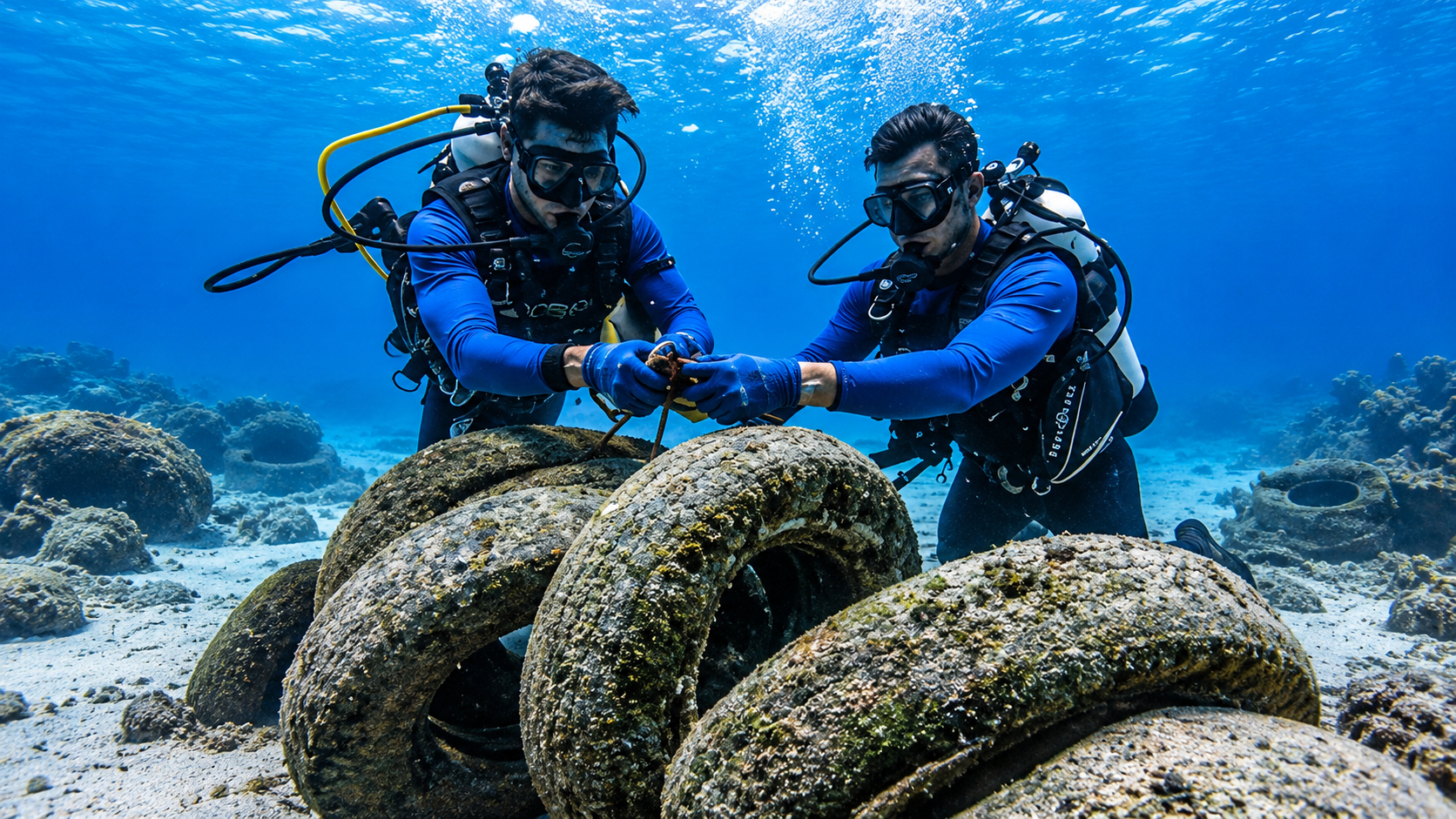
Tires at the site were assembled into bundles using steel clips and cables. Those restraints were exposed continuously to saltwater, an aggressive environment for unprotected or inadequately protected steel. As the connecting hardware corroded, bundles came apart and large numbers of tires became untethered.
Once loose, the tires were no longer a reef system. They were separate pieces of mobile marine debris. Tropical storms and hurricanes supplied the environmental loads needed to move them across the seabed and into nearby natural reefs. The tires struck coral, covered marine habitat and drove away fish the opposite of the project’s intended function.
This failure mechanism highlights a basic systems-engineering problem: the durability of an assembly is governed by more than the expected life of its largest component. Tire rubber could persist underwater, but persistence offered no benefit when the clips and cables controlling location failed first. Long material life actually prolonged the consequences after containment was lost.
A 1974 federal guide to scrap-tire reefs recognized that movement had to be prevented. It evaluated several module designs, including tires held by reinforcing rods, bands, chains and concrete ballast. The guide stated that correctly constructed units should remain on the bottom. Osborne’s later outcome demonstrated how much depended on that condition continuing to hold through corrosion, currents and severe storms.
Placement was only the beginning of the design problem
An offshore structure also needs a credible plan for inspection, degradation and recovery. Hardware can be difficult to examine once submerged, while a field of disconnected tires becomes far harder to retrieve than intact modules. Removal requires divers to locate and handle individual tires, move them to collection points and transfer them for processing or disposal.
Florida environmental officials say the magnitude and complexity of the site prevented any single government agency from removing the tires alone. A federally funded reconnaissance effort in 2006 therefore focused first on developing a possible removal strategy. A pilot program was considered necessary to test diver productivity, loading and transportation methods, and tire processing and disposal.
The state’s posted project information shows how long the remediation horizon has become. One tire-removal contract was renewed in February 2023 and runs through February 2028. Florida also executed an additional removal-services contract in September 2025 that extends to September 2032, with the new contractor working through local, state and federal permitting before operations begin.
The Osborne Reef’s lasting engineering lesson is direct: reuse does not eliminate the need for containment, environmental-load analysis and end-of-life planning. A project designed around millions of durable components also needs restraints durable enough to control them and a recovery method for the day those restraints no longer can.
| More aerospace and engineering stories, right in your MSN feed. Follow AMI on MSN |
By Thomas Caldwell — AMI’s senior editor for mechanical and mobility engineering, covering vehicle electronics, systems integration, electrification, chassis systems, propulsion, and safety policy.