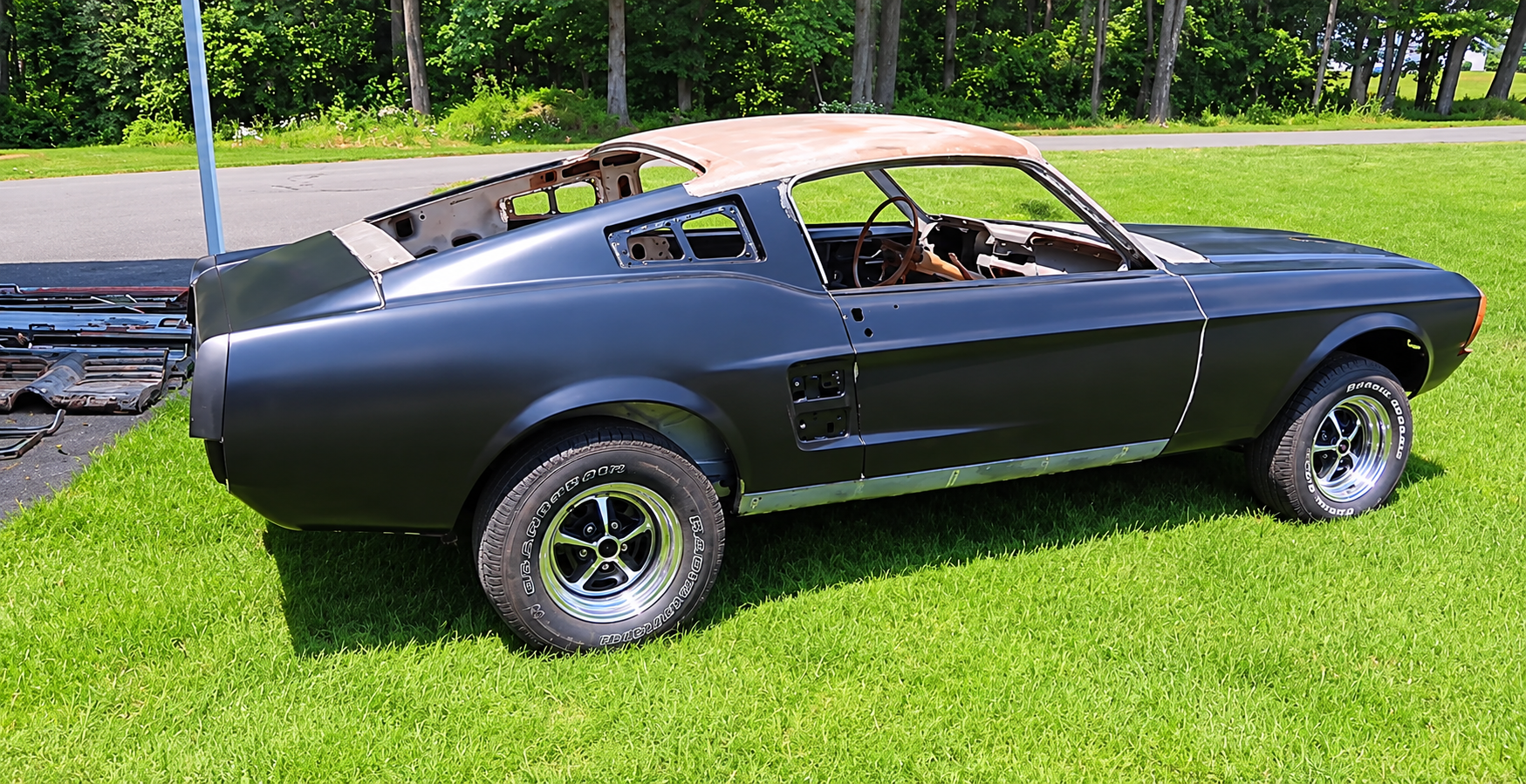
Jiangsu Juncheng Offers $16,000 Mustang Bodies Without Vehicle Identification Numbers
Around $16,000 can buy a newly manufactured body for a 1967 Ford Mustang fastback, free of the corrosion that can consume an original shell. What it does not buy is the car’s legal identity. Jiangsu Juncheng Vehicle Industry Co., Ltd. sells the replacement body without a vehicle identification number, leaving the completed project’s registration, compliance status and authenticity dependent on how it is assembled and where it will be licensed.
The Baoying, China-based manufacturer exhibited its reproduction bodies at the 2026 SEMA Show. Its catalog also includes replacement shells for the Toyota AE86 and Datsun 240Z, with prices beginning at approximately $9,500. Juncheng markets these products as replacement parts rather than complete vehicles, a distinction that makes the body easier to understand as a component but does not automatically settle the status of the car built around it.
For restorers, the engineering appeal is straightforward. Severe corrosion can turn an apparently complete classic into a long fabrication project involving structural repairs, panel replacement and dimensional reconstruction. A new shell can remove much of that uncertainty while avoiding the need to cut up another increasingly scarce survivor. It also gives restomod builders a clean foundation for installing a powertrain, suspension, brakes, wiring and interior selected for the finished project.
Yet a body is the structure that visually defines a classic and carries much of its physical continuity. Replacing it creates a boundary problem: Is the result a restored 1967 Mustang, a reconstructed vehicle based on an existing Mustang, or a newly assembled replica? The answer cannot be determined from the body alone.
A VIN cannot simply be assumed
Registration practices vary by state. Depending on the build and jurisdiction, a car using a Juncheng shell may need to be registered as a specially constructed vehicle. Builders cannot assume that the identity of an unrelated donor car transfers to a new body merely because its mechanical components are installed there. The absence of a VIN therefore affects more than paperwork; it influences titling, inspection and how the finished vehicle is represented to future buyers.
Federal safety treatment is similarly fact-dependent. In a published interpretation addressing kit cars and combinations of old and new components, the National Highway Traffic Safety Administration explained that an automotive body is motor-vehicle equipment rather than a complete motor vehicle. A car assembled entirely from previously unused parts, however, can be treated as a new motor vehicle required to meet and be certified to contemporary federal safety standards. Where used and new parts are combined, the agency has said the component mix must be evaluated according to the particular facts.
That creates a significant systems-integration consequence. A body styled after a 1967 vehicle does not by itself establish that the completed car can be regulated as a 1967 vehicle. NHTSA has previously noted that a replica subject to modern standards may require equipment that prevents complete period authenticity, including newer lighting, restraints and other safety provisions. Alternatively, a build based on a previously registered host vehicle may be treated differently, but its original safety equipment and compliance configuration remain relevant.
Physical accuracy and historical authenticity diverge
The new shell also separates geometric reproduction from historical continuity. It may reproduce the recognizable fastback form and provide sound mounting points, but it does not carry an original production history. Collectors may therefore distinguish sharply between an original-bodied Mustang, a vehicle reconstructed around a replacement shell and a newly assembled replica, even when the cars appear similar.
Replacement bodies themselves are not a new category. Dynacorn Classic Bodies produces officially licensed shells for models including the Ford Mustang, Chevrolet Camaro and Pontiac Firebird. Juncheng does not advertise comparable automaker licensing, introducing a separate intellectual-property and branding consideration from the registration question.
A Bronco restomod reportedly built with a Juncheng shell sold for around $400,000 at Barrett-Jackson, but one auction result cannot establish typical values or resolve how collectors will assess other builds. Documentation remains central: the origin of the body, donor components, assembly history, assigned identity and registration category all shape what the finished machine legally and culturally represents.
Juncheng’s $16,000 Mustang body addresses one of classic-car rebuilding’s hardest physical constraints: finding straight, structurally sound metal after nearly six decades. Its missing VIN shifts the difficulty elsewhere, from rust repair to the more complicated task of establishing the completed car’s identity, compliance basis and authenticity.
| More aerospace and engineering stories, right in your MSN feed. Follow AMI on MSN |
By Thomas Caldwell — AMI’s senior editor for mechanical and mobility engineering, covering vehicle electronics, systems integration, electrification, chassis systems, propulsion, and safety policy.