Tank Flattens Carson Hocevar’s $800 Chevrolet as HOA Member Objects
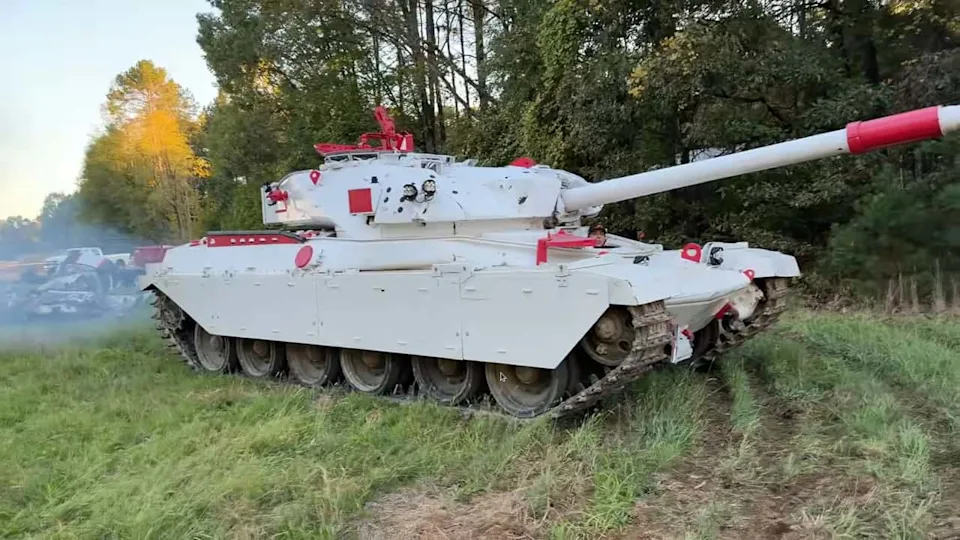
A decommissioned military tank rolled over the hood and roof of NASCAR Cup Series driver Carson Hocevar’s Chevrolet Cobalt, flattening the disabled car in one pass. The Cobalt had started the day as Hocevar’s $800 entry in a cheap-car challenge; it ended as scrap while a homeowners’ association member objected to the tank’s presence.
The destruction was an improvised ending to a loosely organized contest between Hocevar and his friend Vernon Hale. Each had $800 in cash to find a car, with the expectation that the two inexpensive purchases would then face some form of competition.
Hale chose an Oldsmobile Cutlass Supreme that he said required no work. Hocevar bought the Chevrolet and used several cans of spray paint to apply a new finish by hand. Both men considered the result more appropriate for a demolition derby than a residential driveway, but the rough paint was only a cosmetic problem.
The Cobalt failed before the challenge started
The contest unraveled after a fuel stop. Hocevar filled the Cobalt with Unleaded 88, which was described as different from the fuel the engine required. As the Chevrolet left the station, it displayed a power-steering warning.
The pair traced the steering problem to a blown belt. The Cobalt subsequently began backfiring and then stopped running. The sequence does not establish that the fuel caused either the belt failure or the engine shutdown. Unleaded 88 is generally an E15 blend containing 15% ethanol, but approval varies by vehicle age and manufacturer guidance; the Cobalt’s model year was not identified.
The confirmed mechanical problem was the blown belt and resulting loss of power-steering operation not a diagnosed power-steering pump failure. With the Chevrolet unable to propel itself, Hale used the still-running Cutlass to push it home while Hocevar steered. The rattle-can Cobalt and its disabled steering system had effectively ended the planned contest before it began.
A trailer carrying the surplus tank arrived that same day. Rather than continue diagnosing or repairing the Cobalt, the hosts abandoned the challenge and placed the Chevrolet in the tracked vehicle’s path. The tank crossed the hood and passenger compartment, collapsing the body and roof. The flattened wreck was later dragged away to clear the yard.
The tank created its own property constraints
Using the tank around a home involved more than lining it up with the failed car. Its metal road pads could damage pavement if the vehicle turned while on asphalt. A tracked vehicle changes direction by varying the movement of its two tracks, so a turn on a hard surface can make the pads scrape or pivot against the pavement.
The tank’s transport also attracted attention. A neighbor recounted the response to the trailer and its unusual load on the road and at a weigh station. No supported account establishes that a transport violation occurred.
The property’s newly installed septic system imposed another practical boundary. The hosts discussed the risk while maneuvering the tank, and federal guidance supports the underlying concern: the Environmental Protection Agency advises homeowners not to drive or park on a septic drainfield. Heavy vehicles can threaten buried components or compact the soil used to treat and disperse wastewater, although no damage to this property’s system was reported.
An HOA member at the property objected to the tank being there. That was an individual member’s objection, not a documented formal action by the homeowners’ association. Even so, it captured the unusual escalation: two friends set out to compare $800 cars, but a failed belt left one entry disabled before the contest and several tons of tracked armor finished it. The final job was no longer testing the Cobalt it was removing its crushed shell without tearing up the pavement or crossing the new septic system.
| More aerospace and engineering stories, right in your MSN feed. Follow AMI on MSN |
By Robert McKinney — Editor-in-Chief for AMI’s automotive and mobility coverage, with a mechanical engineering background and a decade reporting on powertrain systems, EV innovation, and global vehicle manufacturing.