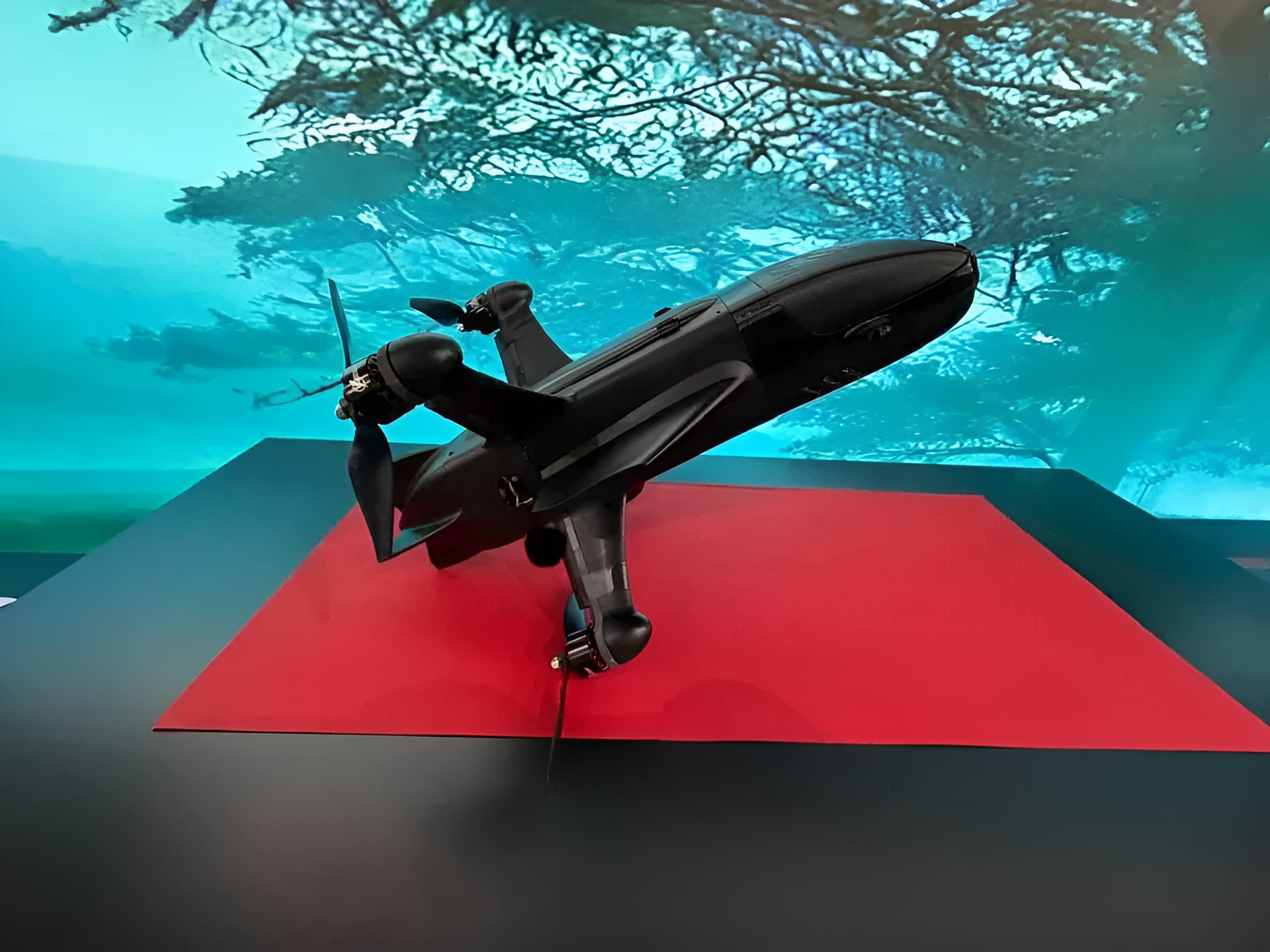
Ukraine’s SPYS Interceptor Redesign Reportedly Reaches 500 Kilometers Per Hour
Ukraine’s Quantum Wiy Industries unveiled a redesigned SPYS interceptor drone on November 19, 2026, reporting a top speed of 500 kilometers per hour and a range of 45 kilometers. The upgrade grew out of prototype testing and links aerodynamic, thermal and electronic changes with an effort to prepare the aircraft for mass production.

Those figures remain company-reported. No independent test results, production quantities, unit costs or manufacturing timetable have been disclosed. The SPYS therefore illustrates both the speed of Ukraine’s drone-development cycle and the harder transition from a promising prototype to a repeatable industrial product.
The redesign began with feedback from crews that tested early aircraft against jet-powered targets. Quantum Wiy narrowed the wings, reshaped the forward fuselage and modified the air intake. It also changed the antenna’s design and location because the earlier configuration reportedly generated substantial aerodynamic drag.
At the SPYS drone’s claimed speed, exposed hardware is more than a packaging detail. Antennas need suitable placement to provide reliable communications, but their shape and location can disturb airflow and add resistance. Reducing that penalty can improve speed or preserve energy for range, although the available information does not quantify how much each aerodynamic change contributed.
The reported range increase from 33 to 45 kilometers is especially relevant because speed, endurance and payload compete for the same limited onboard energy. A faster aircraft can consume power more aggressively, while additional structure or electronics add mass. Quantum Wiy has not published enough test data to separate the benefits of lower drag, revised propulsion integration and other design changes.
A color change addressed a serious heat load
One of the most visible revisions was also one of the simplest: the 3D-printed fuselage changed from black to white. The black version reportedly reached 80 degrees Celsius in summer sunlight, imposing what was described as a critical thermal load on its internal electronics.
Surface color and finish directly affect how much solar energy a structure absorbs. NASA’s reference work on thermal-control coatings notes that solar absorptance and thermal emittance are critical to temperature control and can vary with material formulation, surface preparation and manufacturing technique. For a compact drone, reducing absorbed heat can ease the burden on electronics without adding a separate cooling system, although actual component temperatures depend on airflow, internal layout and operating conditions.
Continuing to print the fuselage allows the company to revise geometry without committing immediately to conventional tooling. That is useful while dimensions, cooling needs and component placement are still changing. Additive production can shorten prototype iteration, but mass manufacture introduces different requirements: consistent dimensions, predictable material properties, quality inspection and stable assembly times must be maintained across many airframes.
Electronics and manufacturing become the next test
Quantum Wiy also reinforced the power electronics, saying the change makes high-speed performance more predictable and allows the aircraft to be reused. That addresses a reliability issue beyond headline speed. An interceptor that reaches its target performance only under narrow electrical or thermal conditions is harder to field consistently than one whose power system behaves repeatably across multiple flights.
The upgraded aircraft includes a radio-beacon positioning arrangement intended to maintain coordinate awareness when satellite navigation is unavailable, along with automatic pointing of the ground station’s antenna to support the communications link. These features show that airframe performance cannot be separated from control and communications reliability: speed has limited value if tracking, position estimation or the data connection becomes unstable.
The SPYS redesign also standardizes previously improvised hardware into an approved factory-made unit, while increasing its supported payload mass from 300 to 500 grams. From a manufacturing perspective, standardization can reduce assembly variation and simplify inspection, but it can also require the airframe, power system and controls to accommodate greater mass consistently.
Preparing for mass production is now the program’s most consequential step. Narrower wings, lower antenna drag, a cooler shell and reinforced electronics each address a problem observed during prototype use. Whether those changes produce a reliable 500-kilometer per hour aircraft at scale will depend on production data Quantum Wiy has not yet released including output, cost, schedule and independently measured performance.
| More aerospace and engineering stories, right in your MSN feed. Follow AMI on MSN |
By Stephen Wallace — Editor for AMI’s aerospace integration and unmanned mobility coverage, focused on drone manufacturing, VTOL systems, autonomous networks, and air-ground mobility links.