USS George Washington Leaves Middle East, Cutting U.S. Carrier Presence to Two
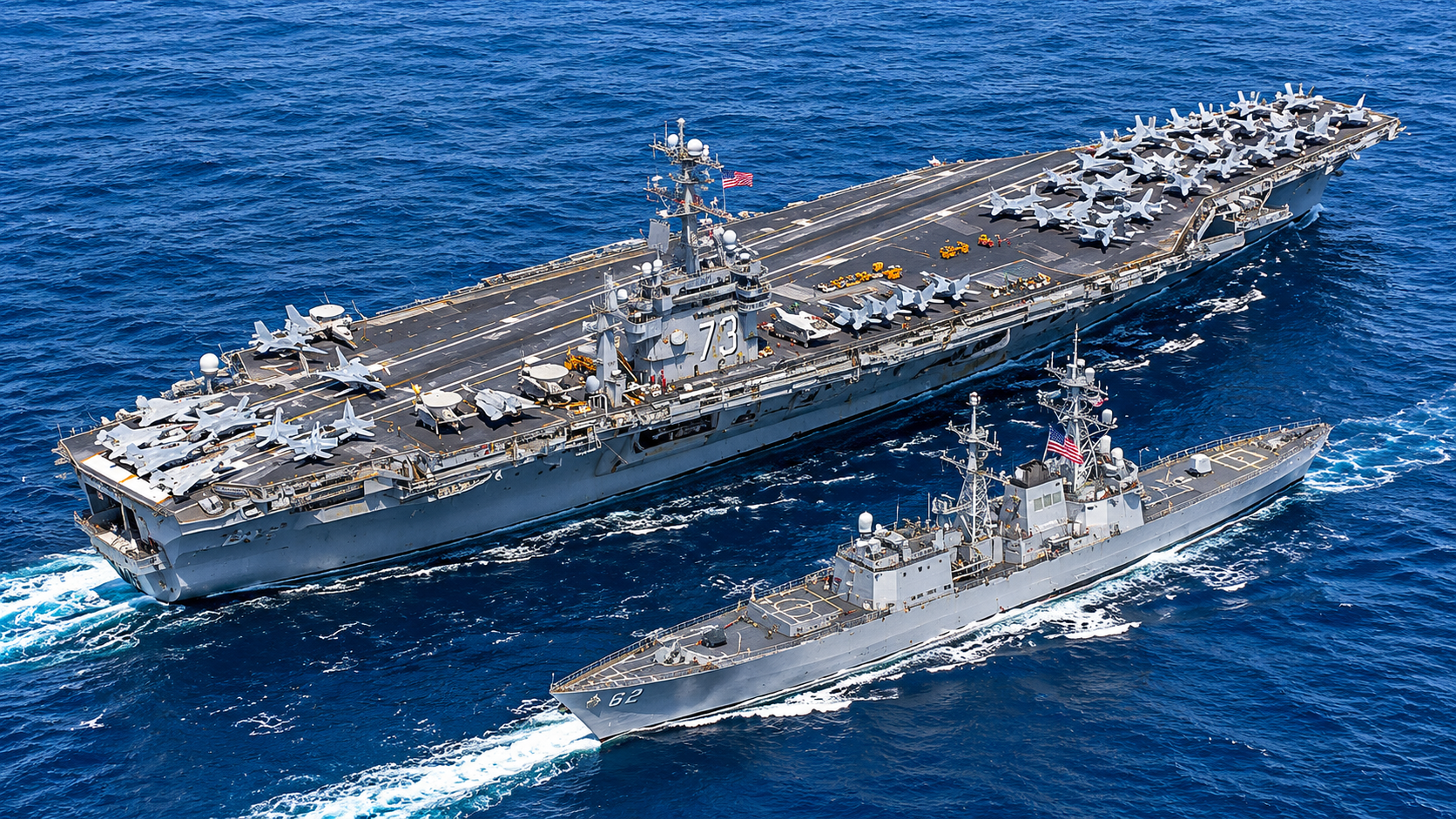
The USS George Washington has left the Middle East and resumed routine operations in the Pacific, ending a brief concentration of three U.S. aircraft carriers in the region. A U.S. Pacific Fleet spokesperson confirmed the Japan-based carrier was back to “conducting routine operations” in its usual operating area on November 18.

The departure reduced the U.S. carrier presence in Middle Eastern waters from three ships to two. USS Theodore Roosevelt had arrived only two days earlier, briefly creating the three-carrier overlap, while USS George H.W. Bush remained in the region after arriving in April.
That sequence makes the change more than a simple departure notice. Theodore Roosevelt’s arrival temporarily increased the available carrier force, but George Washington’s return toward Pacific duties shows that the concentration was a short transition rather than a new sustained level. The Navy has not disclosed how long Theodore Roosevelt or George H.W. Bush will remain in the region, nor has it provided the operational reasoning behind the timing.
A brief overlap, not a permanent buildup
Aircraft carriers are highly visible markers of U.S. naval presence, but their movements also reflect a tightly managed cycle of operations, training and maintenance. Keeping three in one region for an extended period would tie up a substantial portion of the Navy’s carrier fleet and the accompanying personnel and ships needed to support those deployments.
George Washington’s move therefore redistributes a Japan-based carrier toward its Pacific role while leaving two carriers available in the Middle East. The change preserves a sizable regional presence without sustaining the unusual three-carrier concentration.
The Navy’s broader deployment schedule is already under pressure. Senior Navy leaders said in October that sailors deploying with carrier strike groups should expect tours lasting roughly 10 to 11 months for the next couple of years, rather than the commonly cited seven-month norm. According to an account of those remarks by USNI News, Navy leaders linked the longer schedules to current fleet capacity and persistent operational demand.
Chief of Naval Operations Adm. Daryl Caudle said more capacity would be needed to shorten deployment lengths. Master Chief Petty Officer of the Navy John Perryman also warned that longer deployments can lead to longer maintenance periods, affecting when ships become available again. Those comments provide the wider readiness context for George Washington’s departure: carrier presence cannot be measured only by how many flight decks are in one region on a given day. The service must also account for crews, upkeep and the next assignment in each ship’s operating cycle.
Two carriers remain, but the timeline is open
Theodore Roosevelt’s arrival and George Washington’s departure completed a rapid change in regional carrier posture. For two days, three U.S. carriers were operating in waters off Iran. The count then returned to two, with Theodore Roosevelt joining George H.W. Bush as the carriers that remained.
The available information does not specify whether those two deployments will overlap for weeks or months. That uncertainty limits any broader conclusion about the Navy’s longer-term carrier posture in the region. What is confirmed is the completed movement: George Washington is no longer part of the Middle East force and has resumed Pacific operations.
The short-lived three-carrier presence illustrates how quickly a major naval concentration can form during a rotation and how quickly it can dissolve when one ship returns to another theater. With George Washington back in the Pacific, the next consequential change will be the departure or replacement of either Theodore Roosevelt or George H.W. Bush, a schedule the Navy has not yet disclosed.
| More aerospace and engineering stories, right in your MSN feed. Follow AMI on MSN |
By David Whitaker — Associate editor for AMI’s aerospace and drone systems desk, translating flight systems, aircraft programs, spaceflight, and UAV developments into accessible technical stories.