REO Takes $25 Reservations for $21,500 Truck With Suppliers Unconfirmed
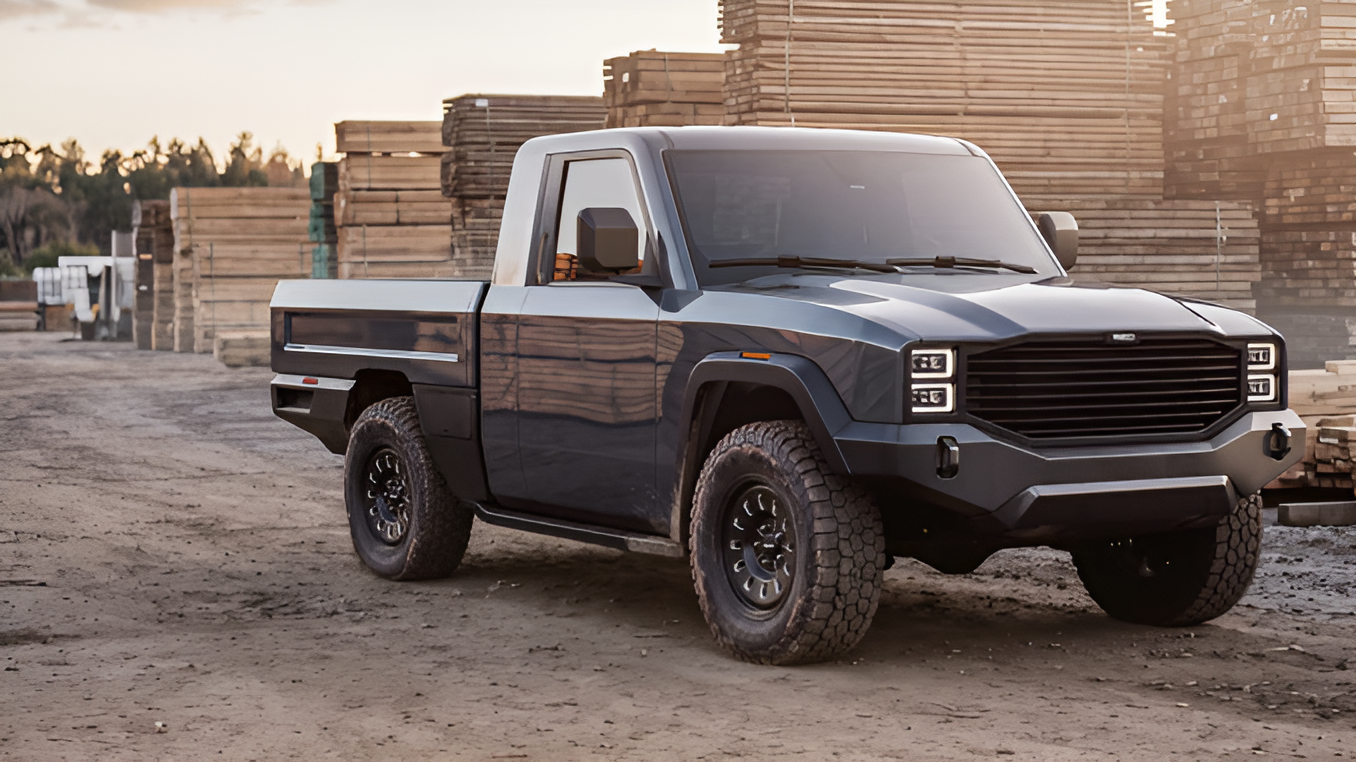
REO Trucks is accepting $25 refundable reservations for a proposed $21,500 four-wheel-drive work truck, although the company has not publicly named its engine supplier, finalized its transmission source or secured the Texas factory intended to build it. The unusually low price and 500,000-mile powertrain-life goal offer an appealing alternative to increasingly expensive pickups, but both remain targets rather than validated production results.
The company says it has collected more than 40,000 reservations for the Runabout lineup revealed on November 16. A reservation establishes an approximate place in line; it is not an order and does not lock in the final price. REO is targeting pilot builds in 2027 and initial T4X deliveries from late 2028 into early 2029.
A deliberately conventional truck
REO’s proposed architecture is credible as a strategy for reducing mechanical complexity. The two-seat T4X work truck, five-seat T4C crew cab and six-seat S4C SUV would share a 119.6-inch-wheelbase ladder frame, common powertrain and common front structure. That parts commonality could spread engineering, tooling and inventory costs across three models.
The drivetrain blueprint calls for a naturally aspirated, port-injected four-cylinder gasoline engine, a standard six-speed manual transmission and mechanical part-time four-wheel drive with a floor-operated low range. Solid axles, front coil springs, rear leaf springs and rear drum brakes favor established hardware over more elaborate alternatives. REO also proposes stamped-steel panels, physical cabin controls and readily removable trim.
Repairability extends beyond the chassis. According to REO’s Runabout announcement, the company plans to provide a free service manual and a public parts catalog with 20 years of support. It also proposes eliminating software-based parts pairing and supplying a glovebox tool set intended to fit every fastener on the vehicle. Those choices could reduce some repair barriers if REO establishes the promised parts and service operation.
Simplicity does not settle the production cost
The central feasibility gap sits between a mechanically straightforward design and a certified, warrantied vehicle produced at scale. A preliminary component estimate places the bill of materials between $10,600 and $19,100 per truck. That range excludes research and development, tooling, plant preparation, manufacturing overhead, warranty reserves and profit margin. Estimated safety and crash-related hardware and engineering add roughly $1,100 to $3,100 per vehicle, although final costs would depend on the completed design and production volume.
REO lists platform targets of 2,500 pounds of payload, 5,000 pounds of towing capacity and 22 to 25 mpg combined. It has not released engine displacement, horsepower or torque, and the fuel-economy figure is not an EPA rating. Until the engine, transmission, vehicle weight and final calibration are fixed, the interaction among payload, towing performance, drivability, emissions and fuel consumption cannot be validated.
The 500,000-mile powertrain target carries a similar boundary. Avoiding turbocharging, direct injection and automatic stop-start removes several components and operating demands, but architecture alone cannot establish service life. Durability also depends on the selected engine and transmission, cooling capacity, lubrication, material specifications, supplier quality, assembly control, validation cycles and real-world duty conditions. REO has not yet identified the production powertrain against which that lifespan could be demonstrated.
Certification and the factory remain major gates
Before any Runabout can reach customers, REO must complete applicable federal safety work and emissions certification. The EPA requires vehicles and engines to be covered by a certificate of conformity before entering commerce, based on prescribed emissions testing. Compliance also continues through production and customer use rather than ending with a prototype test.
Manufacturing presents another capital-intensive step. REO intends to prepare an existing brownfield plant in Texas, but it has not named or finalized that facility. Converting a site still requires production equipment, stamping dies, assembly processes, trained workers, quality systems and a supplier logistics network. A simple vehicle may reduce the number of parts moving through that system, but it does not eliminate the system.
The T4X’s $21,500 estimate is therefore best understood as the design objective around which REO is organizing the truck, not an established retail outcome. The next meaningful milestones will be a named powertrain, a secured factory and physical pilot vehicles capable of certification and durability testing. Until those commitments are in place, the $25 reservation buys a refundable position behind a proposal not a confirmed $21,500 truck.
| More aerospace and engineering stories, right in your MSN feed. Follow AMI on MSN |
By Thomas Caldwell — AMI’s senior editor for mechanical and mobility engineering, covering vehicle electronics, systems integration, electrification, chassis systems, propulsion, and safety policy.