Air Force One Flies Shenzhen to Maryland Nonstop, Record Claims Unconfirmed
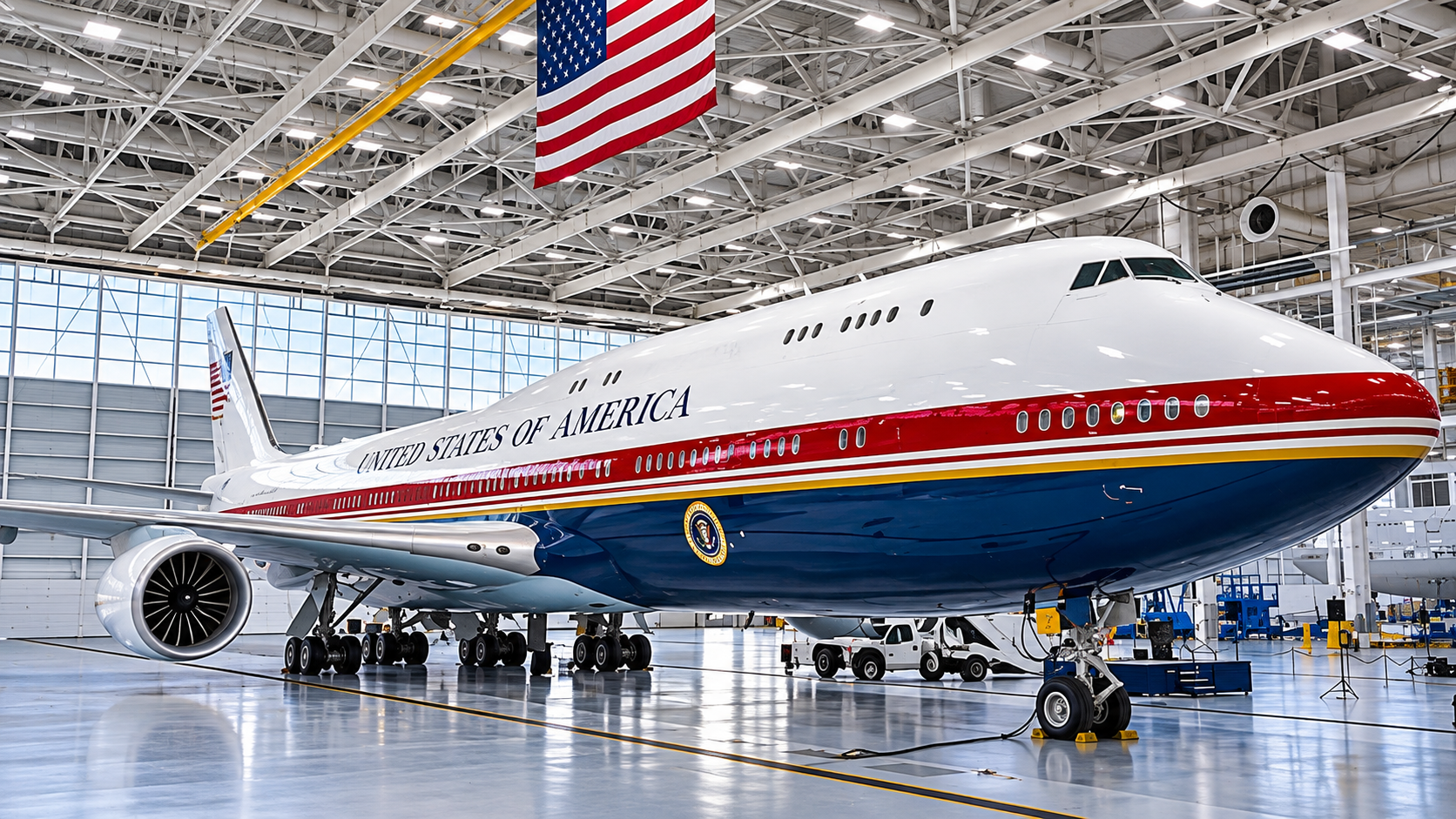
Air Force One completed a roughly 7,500-nautical-mile flight from Shenzhen, China, to Joint Base Andrews, Maryland, without stopping for fuel. The nearly 15-hour mission on November 19 demonstrated the long-range utility of the converted Boeing 747-8 serving as the interim presidential aircraft, even as two records claimed by the White House remain unconfirmed.
The aircraft departed Shenzhen at 5:54 p.m. local time and landed at Andrews at 8:01 p.m. Eastern time. A post-landing press-pool report recorded “no refueling stop,” while flight details reported by TWZ put the distance at about 7,500 nautical miles. The completed nonstop trip is the firm result; the record status is less settled.
Two claims still need independent confirmation
A card distributed to reporters traveling aboard the aircraft said it had conducted “the heaviest takeoff in Air Force history, at just under one million pounds,” and completed “the longest, nonstop Air Force One sortie to date, at nearly 15 hours.” The White House also described a route passing Shanghai, Tokyo, Shemya, Winnipeg and Cleveland, with the aircraft cruising at 33,000 feet and averaging 500 knots.
Neither the Air Force nor Boeing had independently confirmed the records, and no independent takeoff-weight check had been published. Establishing an endurance record would require a reliable comparison against previous Air Force One missions and a consistent definition of sortie duration. Verifying the weight claim would require authoritative loading and fuel data, not simply the observed flight path or elapsed time.
The “just under one million pounds” figure is plausible within the broad dimensions of the aircraft but is not independently established. The commercial 747-8I has a maximum gross takeoff weight of 987,000 pounds. A record claim spanning the entire Air Force would also require comparison with other very large aircraft and their documented operating weights.
Why flying nonstop matters
The aircraft is a former Qatar Amiri Flight 747-8I business jet converted by L3Harris into an interim presidential transport. It first carried the president in July 2026 and is commonly described as the VC-25B Bridge aircraft. Unlike the older VC-25A presidential jets, it cannot receive fuel in flight.
That limitation makes onboard fuel capacity, aircraft weight, weather and routing decisive when planners consider a long mission. A fuel stop adds ground time and another takeoff and landing cycle, while aerial refueling would provide a way to extend endurance without landing. The Bridge aircraft had no such option on the return from southern China, so completing the trip nonstop was a direct demonstration of usable range rather than a theoretical specification.
The estimated 7,500-nautical-mile route sits close to the nearly 7,800-nautical-mile range Boeing quotes for a commercial 747-8I. Those figures cannot be treated as interchangeable: range varies with payload, configuration, reserves, winds and operating profile. The precise maximum range of the converted presidential aircraft has not been published.
The comparison with the older aircraft is still instructive. The Air Force lists the VC-25A’s unrefueled range at about 6,800 nautical miles. Although the VC-25A can be refueled in flight, that capability is reserved for emergencies. For an ordinary long-distance return mission, the Bridge aircraft’s 747-8 airframe delivered enough reach to eliminate a fuel stop that the older platform would generally require.
Range is only one part of endurance
A 15-hour sector also places demands on crew scheduling and rest. Air Force research on maximum-endurance flight operations identifies extended wakefulness, circadian disruption and crossings of multiple time zones as fatigue risks. The research emphasizes planned work-rest schedules and fatigue-management training for long missions. It does not evaluate this specific presidential flight, but it shows why aircraft range alone does not define sustainable long-duration operations.
The two permanent VC-25Bs now being converted by Boeing will also lack aerial-refueling capability. Their stated range requirement was reduced from about 7,100 to 5,900 nautical miles, although a requirement is not necessarily the aircraft’s final demonstrated limit. Unless those more extensively modified jets substantially exceed that figure, they may not be able to repeat the Shenzhen to Maryland route nonstop.
The Bridge aircraft has already supplied the most consequential evidence available: it crossed the Pacific and continued to Maryland without taking on fuel. Confirming the larger claims now depends on the Air Force or Boeing publishing authoritative mission-duration and takeoff-weight records.
| More aerospace and engineering stories, right in your MSN feed. Follow AMI on MSN |
By David Whitaker — Associate editor for AMI’s aerospace and drone systems desk, translating flight systems, aircraft programs, spaceflight, and UAV developments into accessible technical stories.