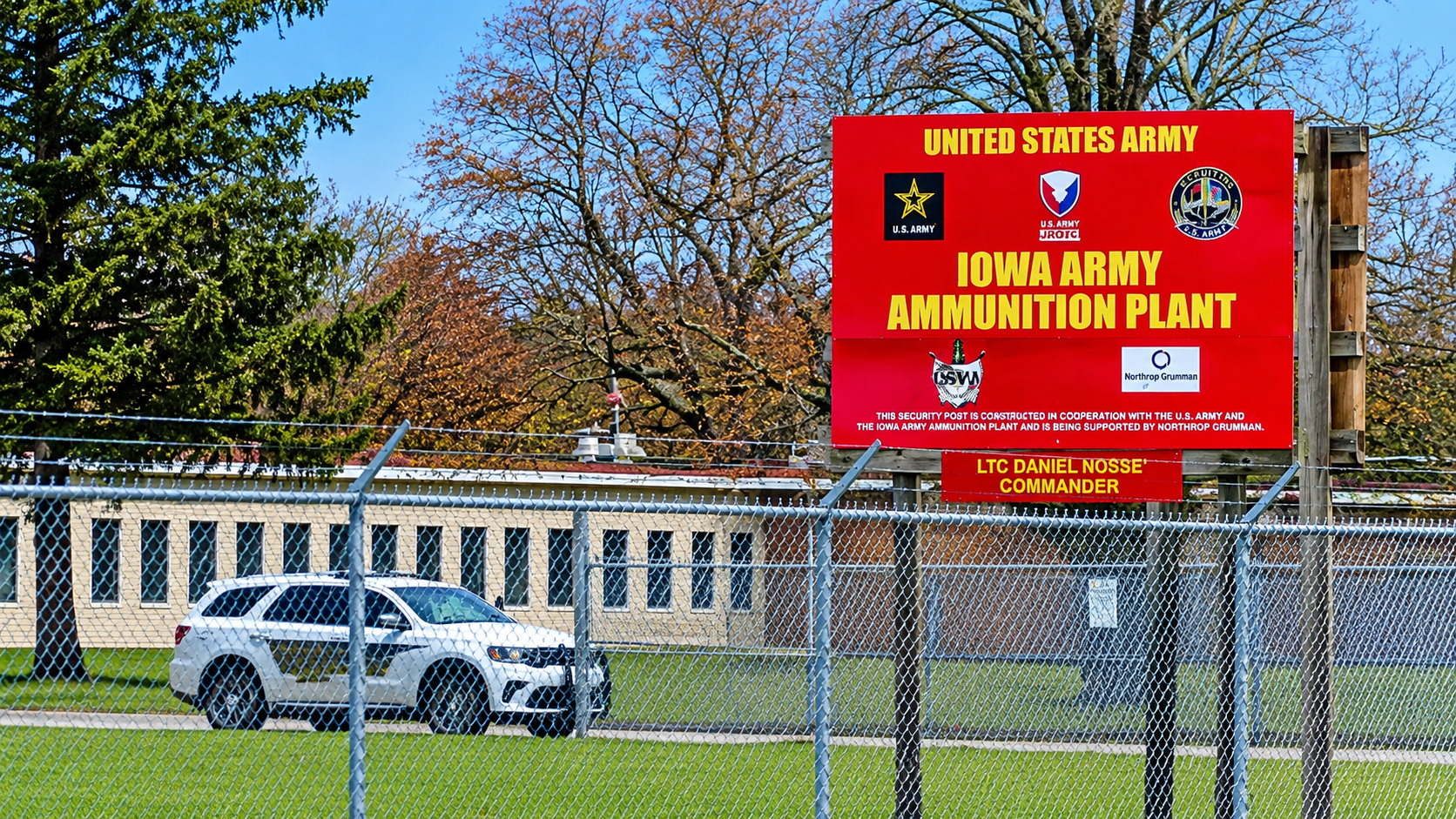
Army Ordered to Halt Iowa Blast, Leaving 68 Unstable Barrels in Place
Stopping a controlled explosion does not remove the hazard that prompted it. The U.S. Army has been ordered to halt a disputed disposal operation at its ammunition plant in Middletown, Iowa, leaving 68 barrels of degraded lead azide in place while officials weigh two different risks: an asserted possibility of spontaneous explosion during continued storage and the potential spread of lead particulates during detonation.
President Donald Trump said on Monday, November 23, that the Army must not proceed unless the Eighth Circuit Court of Appeals and Iowa governor-elect Rob Sand approve. The restriction follows an emergency court intervention blocking the operation, environmental litigation and Justice Department filings indicating that the Army intended to invoke an emergency provision and proceed. No explosion or lead exposure from the planned operation has been reported.
The barrels were discovered in March and contain several tons of degraded lead azide, an explosive used in munitions. The Army has characterized the material as unstable and said a controlled detonation is needed to avoid the risk of a spontaneous explosion. Its advisory also warned that lead particulates could travel as far as 100 miles, creating a sharply different concern for residents beyond the plant boundary.
A choice between hazards, not between danger and safety
The immediate policy problem is that delay changes the risk profile rather than eliminating risk. Continued storage retains material the Army considers unstable. Moving or treating explosive hazardous waste can also present handling constraints; the Environmental Protection Agency notes that some waste explosives cannot safely be disposed of through other treatment modes.
Detonation would address the explosive inventory, but it transfers part of the safety burden into environmental controls and public exposure management. The Army’s public advisory said the planned operation would produce noise, ground vibration and a dust plume containing some lead. It called for residents in one neighborhood to vacate temporarily because of possible localized window damage.
The planned safeguards included earthworks, soil wetting, perimeter air monitoring and environmental sampling around the blast area. Those measures are intended to limit and measure consequences; they do not make the event emission-free. The Army expected dust to linger for no more than an hour, depending on wind speed, while the broader particulate-dispersion warning has driven concern well beyond the immediate evacuation area.
This creates an access and fairness issue for affected communities. The Army controls the material and the technical operation, but residents may bear the disruption and potential environmental consequences. Residents objected both to possible lead exposure and what they considered inadequate notice. A temporary place to stay was offered for people in the specified neighborhood, including accommodations for pets, but a short evacuation addresses immediate blast effects more directly than questions about particulate deposition and later exposure.
Approval now spans courts, state leadership and federal regulators
The operation had been permitted by the EPA under the Resource Conservation and Recovery Act. Federal rules generally prohibit open burning and open detonation of hazardous waste, with an exception for waste explosives that cannot safely be treated by other means. Facilities using that exception must demonstrate that they remain eligible, and safe available alternatives must be used when they exist.
That framework makes the unresolved technical issue narrower than a simple vote for or against detonation: decision-makers need to establish whether another treatment method is suitable for this specific degraded material, whether it can be handled or transported safely, and whether the proposed controls adequately contain and measure the detonation’s byproducts. The available information does not identify a confirmed alternative for these 68 barrels.
The EPA says more enclosed technologies are preferred because they can capture and treat byproducts before release, while open detonation releases most treatment byproducts into the environment. It also recognizes that explosive-waste characteristics can restrict the available options. Any comparison therefore has to account for the full operation stabilization, handling, transport, treatment and residual waste not merely the final destruction step.
Lead adds a demanding public-health boundary. The CDC says no safe blood-lead level has been identified in children, although its blood-lead reference value is a population screening measure rather than a toxicity threshold or regulatory limit. That makes air sampling and post-operation environmental measurements central to accountability if a detonation is eventually authorized.
The Army did not respond to a request for comment Monday. Until the required judicial and state approvals are resolved, the plant remains responsible for securing material it considers unstable, while officials still lack an approved disposal path that settles residents’ concern about a potentially far-reaching lead plume.
| More aerospace and engineering stories, right in your MSN feed. Follow AMI on MSN |
By Thomas Caldwell — AMI’s senior editor for mechanical and mobility engineering, covering vehicle electronics, systems integration, electrification, chassis systems, propulsion, and safety policy.