Fehmarnbelt Gasket Delay Shows How 650-Foot Tunnel Sections Join Underwater
A rubber gasket illustrates how the act of sinking an immersed-tunnel section is inseparable from the precision required to keep the finished crossing dry. On November 13, 2026, the Fehmarnbelt project between Denmark and Germany postponed the immersion of its fifth element after damage was found on the preceding element’s GINA rubber gasket. The project described the damage as mostly superficial and said repairs were underway; it may have occurred during cleaning and preparation of the tunnel trench.
The delay puts a practical consequence behind a counterintuitive construction method also used for Baltimore’s Fort McHenry Tunnel. Prefabricated tunnel sections can be as long as 650 feet, or 200 meters, yet they must temporarily behave like stable watercraft. Engineers seal their ends with bulkheads, float them out of a dry dock, tow them into position and lower them into a trench. Only then can the sections be joined closely enough for their gaskets and secondary seals to create a watertight crossing.
A tunnel section designed to float
An unfinished section floats for the same basic reason as a barge: its sealed volume displaces enough water to support its weight. Although the structure may contain enormous quantities of concrete and steel, much of its enclosed interior remains air. Temporary bulkheads at both ends prevent water from entering and preserve that buoyant volume.
Floating is only the first requirement. The element must also resist excessive rolling or tipping while tugboats move it from a dry dock, shipyard or purpose-built fabrication basin. Its weight distribution, center of gravity and center of buoyancy therefore matter before the structure carries a single vehicle or train. Internal tanks can help engineers manage draft and balance during this temporary marine phase.
Fort McHenry demonstrates why a transportation agency might accept that complexity. The original proposal for carrying Interstate 95 across Baltimore Harbor was a tall, double-deck bridge between Fort McHenry and Lazaretto Point. Accommodating large ships would have required substantial clearance and long approaches, consuming surface land and competing visually with the historic fort. The crossing went beneath the harbor instead.
When it opened in November 1985, the Fort McHenry Tunnel was the world’s largest underwater highway tunnel and the widest vehicular tunnel built by the immersed-tube method, according to the Maryland Transportation Authority. Its eight lanes run through two side by side tubes beneath the Patapsco River.
Sinking is a controlled loss of buoyancy
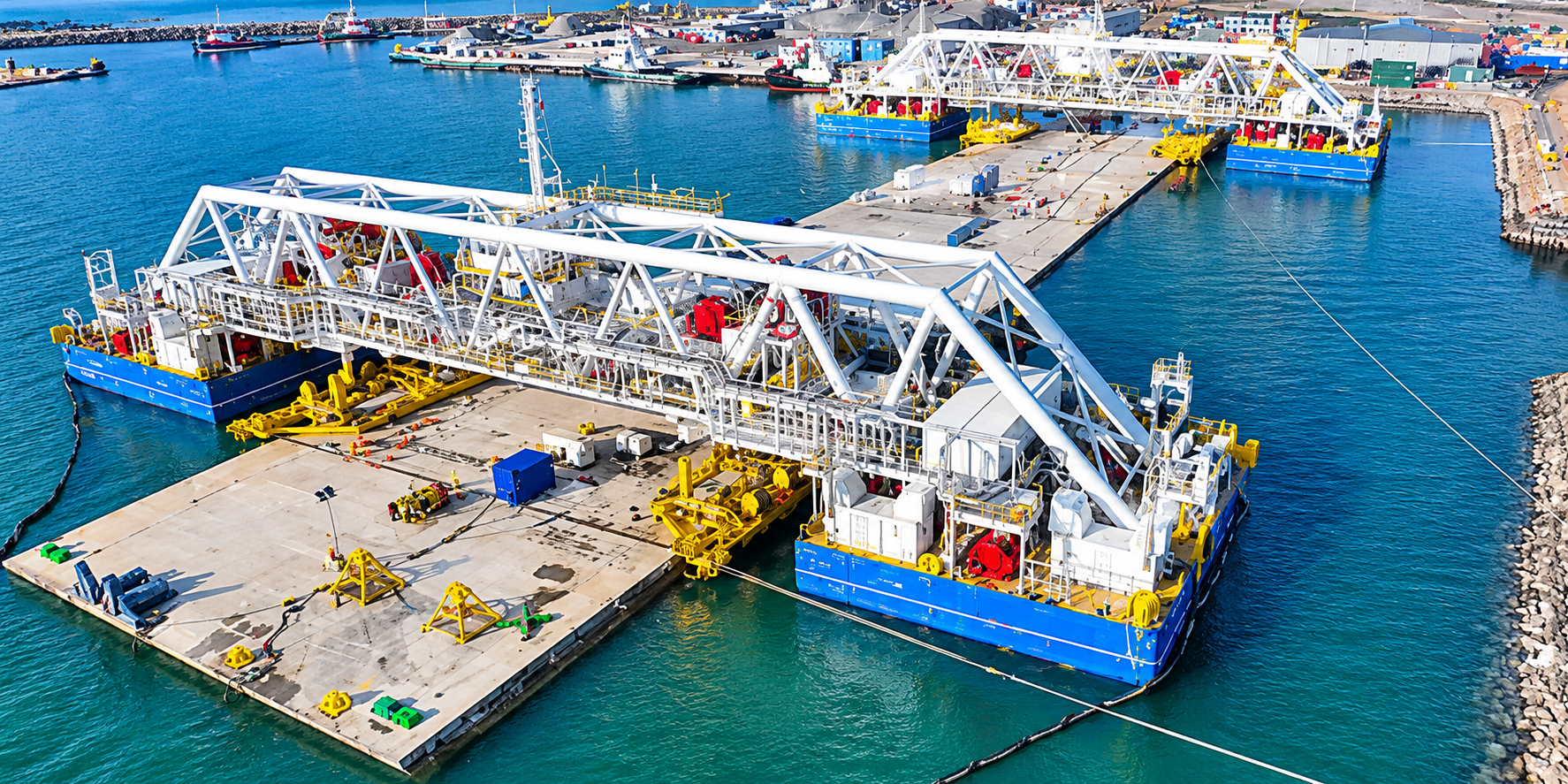
At the crossing, a catamaran-style lay barge holds the floating section over a dredged trench. Water is admitted into ballast tanks in a controlled sequence, increasing the element’s effective weight until it begins to descend. Cables and lowering equipment constrain its movement while crews guide it toward a prepared foundation.
The section does not simply land on an irregular channel bottom. Rock or gravel is placed in the trench, potentially through a fall pipe, and leveled with a steel screed. The resulting bed supports the element and helps establish the alignment needed to meet the section already installed.
Hydraulic jacks or couplers can then draw the new element against its neighbor, compressing a rubber gasket around the joint face. Water trapped between the two temporary bulkheads is drained. That creates a pressure difference, allowing the surrounding water pressure to push the elements together more firmly. Keys or dowels transfer shear forces, while an omega-shaped internal seal provides a second water barrier.
The Fehmarnbelt postponement shows why trench condition and gasket condition cannot be treated as separate details. A section may complete fabrication, flotation, towing and lowering preparations, yet installation still depends on an intact sealing interface at the preceding element. The project said immersion would resume after gasket repairs were completed and weather conditions permitted.
The shallow route carries an environmental cost
Immersed construction can produce a shorter crossing than alternatives requiring long bridge approaches or deep bored-tunnel gradients. Rectangular sections can also accommodate wide combinations of road and rail passages more readily than circular bores. Those advantages are purchased with substantial dredging.
Trench excavation can disturb habitat, increase turbidity and mobilize buried contaminants. Sealed clamshell buckets can reduce sediment movement, while scheduling can avoid sensitive periods such as wildlife migrations. Where contaminated sediment is present, the material may require controlled removal, dewatering, treatment and disposal rather than ordinary excavation.
Once positioned, the sections are secured with angular locking fill and covered as the bed is restored. The bulkheads are eventually removed, opening a continuous interior for roads or tracks, ventilation, lighting, drainage and pumps. Drivers passing through Fort McHenry encounter an ordinary highway environment, but each immense section reached that fixed, watertight state only after serving as a carefully balanced vessel.
| More aerospace and engineering stories, right in your MSN feed. Follow AMI on MSN |
By Thomas Caldwell — AMI’s senior editor for mechanical and mobility engineering, covering vehicle electronics, systems integration, electrification, chassis systems, propulsion, and safety policy.