Ford EV Pickup Prototype’s Rear Port Could Ease Supercharger Access
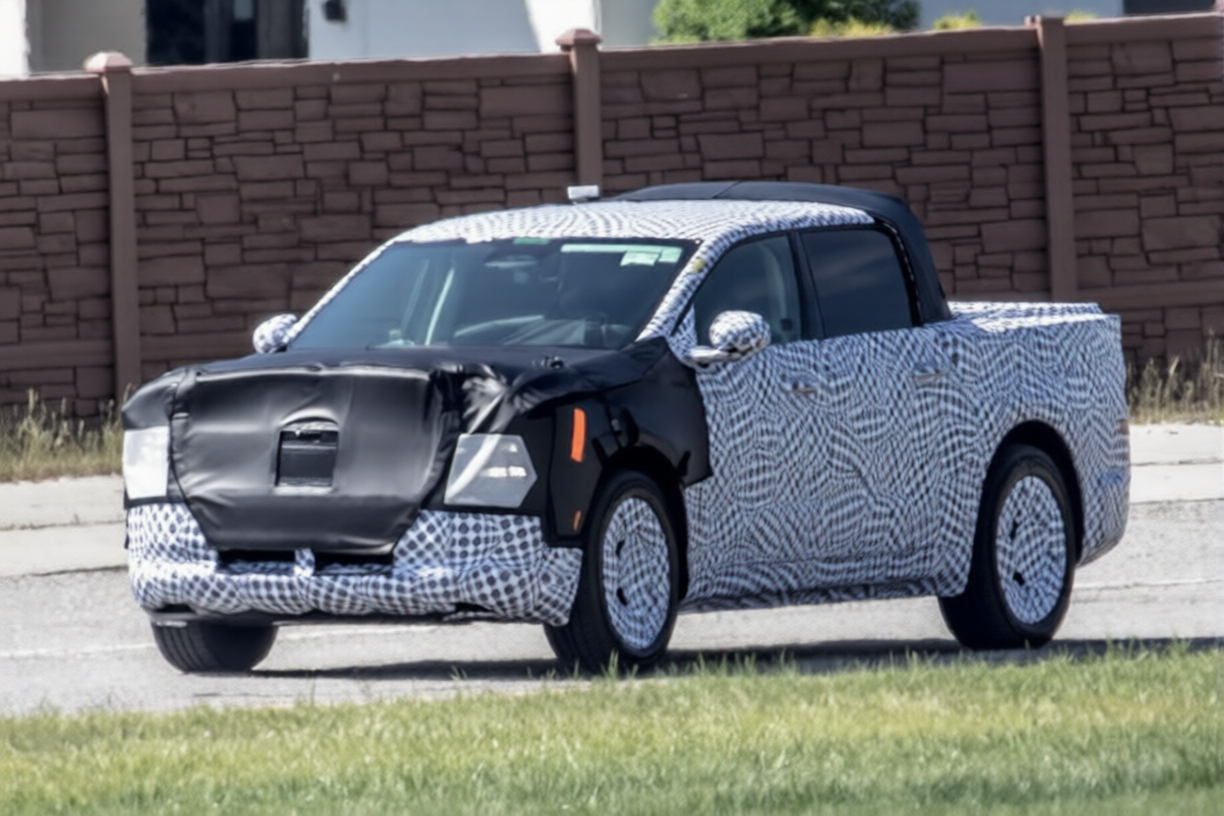
Two camouflaged prototypes of Ford Motor Company’s planned affordable electric pickup were reported charging at a Tesla station with their ports on the driver-side rear fenders, according to a July 22, 2026 update from Electrek. The trucks were backed into their spaces, placing each port close to the station’s short cable. Although prototype hardware is not a production guarantee, this layout could let future owners use many existing Superchargers without blocking an adjacent charging space.
That is a practical packaging decision rather than a cosmetic detail. Many Tesla charging sites were designed around vehicles with ports at the left rear or right front. A non-Tesla vehicle with its inlet farther away may have to park across a line or occupy one space while using the cable assigned to another, reducing the site’s effective capacity.
Ford’s Mustang Mach-E and F-150 Lightning use left-front-fender charging ports. That location can be less convenient at some short-cable Superchargers, depending on stall and parking geometry. Moving the inlet to the left rear would align the new pickup more closely with the physical layout around which much of Tesla’s network was built.
Compatibility includes the cable, not only the connector
Ford’s forthcoming pickup is expected to be its first model with a native North American Charging System port, allowing compatible Supercharger use without an adapter. Yet adopting the connector addresses only one layer of infrastructure integration. Cable reach, parking orientation, trailer clearance, accessibility and the accuracy of stall-availability data can all affect whether a nominally compatible vehicle works smoothly at a station.
Tesla has been adding longer cables at sites prepared for newer charging hardware, which should make the network more accommodating to vehicles with varied inlet positions. It has also modified more than 1,500 sites to improve cable reach, according to a Green Car Reports account of Tesla’s charging updates. However, the installed network still includes many short-cable stalls. Designing around those existing constraints could provide a near-term usability benefit even as station hardware evolves.
The observation does not confirm charging power, charging time, battery capacity or driving range. It also does not establish that every production version will retain the prototype inlet location. Those details remain unresolved, as do the truck’s final dimensions and production name. Ford holds a trademark for the historic Ranchero name but has not confirmed that it will be used.
Port placement is one element of a broader cost strategy
Ford previously announced that the pickup is intended to reach the U.S. market in 2027 with a target price of roughly $30,000. That figure is a target, not a final sticker price. The engineering program pairs charging-network compatibility with several disclosed efforts to reduce material, battery and assembly costs.
The planned structure uses large cast-aluminum components. Consolidating multiple stamped and joined parts into larger castings can reduce part count and joining operations, although it also puts greater demands on casting quality, dimensional control and repair planning. Ford’s revised production system will keep major subassemblies separate for longer, allowing components to be installed with better access before the sections are joined. The pickup is planned for production at Ford’s Louisville, Kentucky, factory.
Ford also plans to use lithium iron phosphate batteries. LFP chemistry is generally selected for lower cost and reduced dependence on nickel and cobalt rather than maximum energy density. For an affordable pickup, that choice makes packaging efficiency and aerodynamic load particularly important because a larger battery would add cost and mass.
The prototypes appear approximately comparable in size to the Maverick, possibly slightly larger. Their lower nose and descending roofline suggest attention to airflow, but no drag coefficient or confirmed aerodynamic benefit has been released. Any resulting range or efficiency advantage therefore remains unquantified.
The left-rear inlet is a small but systems-level clue: Ford appears to be considering the installed charging network as part of the vehicle’s packaging envelope, not merely fitting the correct electrical connector. If retained for production, it would remove one avoidable source of charging friction while Ford’s cast structures, LFP battery and revised assembly process carry the much harder burden of meeting the truck’s affordability target.
By Thomas Caldwell — AMI’s senior editor for mechanical and mobility engineering, covering vehicle electronics, systems integration, electrification, chassis systems, propulsion, and safety policy.