UC San Diego’s $22.9 Million Clot-Removal Robot Grows From Its Tip
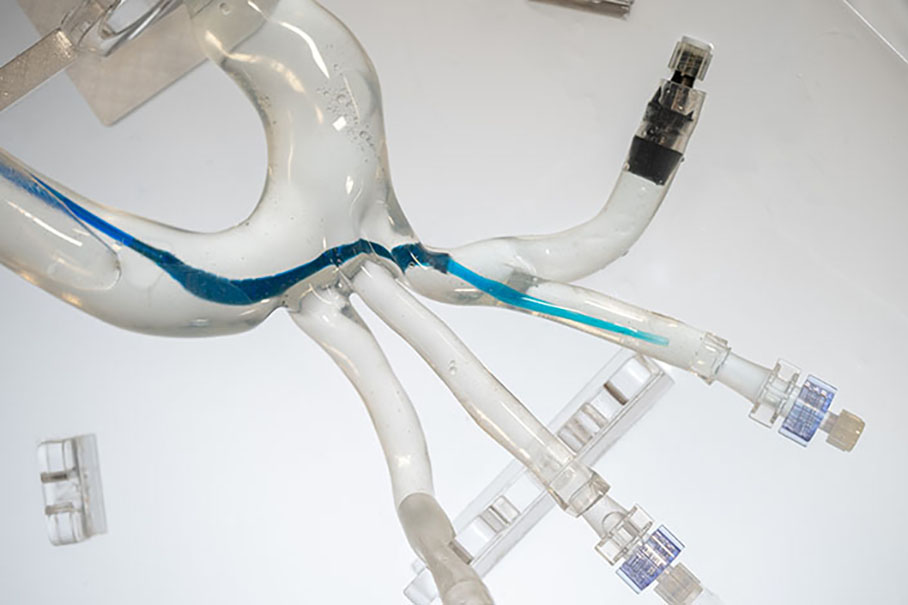
The proposed clot-removal robot does not move through an artery by pushing a catheter’s full length forward from outside the body. Instead, fluid pressure turns its thin-walled tube outward at the leading edge, adding material at the tip while the body behind it remains substantially stationary. This process, known as tip eversion, is the central mechanical idea behind a UC San Diego-led effort to develop a soft autonomous robot for cerebral thrombectomy.

The Advanced Research Projects Agency for Health has awarded the team up to $22.9 million through its Autonomous Interventions and Robotics program. The funding is contingent on meeting accelerated milestones, and the five-year objective is a working prototype for preclinical research not an approved clinical product or a system proven in humans.
Tip eversion changes how the device’s motion is generated. A conventional semi-rigid catheter is advanced from its base, transmitting forces along a device moving through curved anatomy. The UC San Diego concept is intended to extend locally at the tip and conform to tortuous, three-dimensional vascular paths. The research team expects this architecture to exert less force than conventional thrombectomy tools, although that anticipated advantage still has to be established through the program’s testing.
Tania Morimoto, an associate professor in UC San Diego’s Department of Mechanical and Aerospace Engineering, is leading the effort. Her laboratory has previously demonstrated everting robots in models of human arteries, the gastrointestinal tract and an airway. Those demonstrations establish a mechanical research basis for navigating anatomical models, but no human testing was reported.
Mechanical compliance must work with imaging and control
A soft structure alone cannot execute a thrombectomy. The program must integrate its pressure-driven actuation with medical imaging, navigation decisions and clot-removal hardware. Under the proposed workflow, technicians would insert the robot through the femoral artery. A remote physician would oversee its progress, with navigation informed by preoperative and contrast-enhanced imaging.
The planned control architecture combines embedded mechanical intelligence with hierarchical, uncertainty-aware and explainable autonomous decision-making. In systems terms, the compliant body provides part of the behavior through its mechanics, while the control system must interpret imaging, manage uncertainty and select actions at different levels of the procedure. “Explainable” decision-making is particularly consequential in a medical setting because operators and regulators will need to understand how the system reaches decisions rather than treating autonomy as an opaque command source.
At the clot, the proposed robot would use aspiration, then retract under continuous suction. It would inject contrast to verify that the affected vessels had reopened. The team also aims to support angiography and coil embolization with the same platform, expanding the development problem beyond navigation and aspiration to multiple image-guided tasks.
That scope creates a demanding integration exercise. Actuation, sensing, imaging and suction cannot be treated as separate subsystems when each can affect the device’s position and the information available to its controller. The remote physician’s role must also remain clear as autonomy increases: oversight is part of the proposed workflow, even though the research program ultimately targets autonomous intervention capabilities.
A five-year prototype remains several steps from deployment
The consortium includes six universities UC San Diego, UC Santa Barbara, Vanderbilt, UNC Chapel Hill, Stanford and the University of Missouri-Kansas City and three industry partners: GE HealthCare, EndoTheia and Vine Medical. That structure reflects the range of work required, from soft-robot design and controls to imaging, clinical workflow and device development.
ARPA-H has set program-level demonstrations at two important points. At 24 months, participating teams are expected to demonstrate autonomous capabilities in a benchtop or biological model. At 60 months, they are expected to demonstrate fully autonomous surgical interventions in realistic models, animals or human cadavers. For the UC San Diego team, the stated five-year goal is a prototype suitable for preclinical research.
Regulation is an additional design constraint rather than a final administrative step. The team plans to coordinate closely with the Food and Drug Administration because this type of autonomous medical system has no approval precedent, according to the project description. Testing will therefore have to address not only whether the robot can reach and remove a clot, but also whether its behavior can be validated when imaging is incomplete, anatomy varies and control decisions carry uncertainty.
The access objective is substantial: ARPA-H reports that only 12% of eligible stroke patients receive thrombectomy and that more than half of Americans live over an hour from a hospital capable of performing it. The soft robot is intended eventually to extend that capability to rural and lower-resource U.S. hospitals. Before that ambition can be evaluated clinically, however, the immediate engineering test is concrete: turn tip-growing motion, imaging and uncertainty-aware control into a repeatable preclinical intervention within five years.
| More aerospace and engineering stories, right in your MSN feed. Follow AMI on MSN |
By Jonathan Barrett — Editor for AMI’s future mobility and autonomous systems section, with two decades covering robotics, e-mobility, drone-vehicle convergence, and transport mechanical systems.