PI V-783 Brings 310-Millimeter Travel to Mechanical-Bearing Wafer Automation
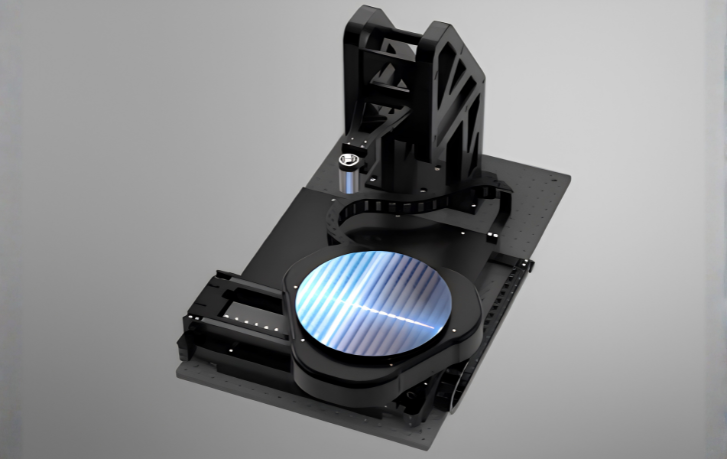
Direct-drive motors move the PI V-783 stage without the screws, belts or gear components that can introduce backlash and drivetrain play. PI has combined that drive architecture with mechanical bearings, a monolithic two-axis structure and nanometer-resolution position feedback, creating a U.S.-made platform for semiconductor inspection and precision automation systems that do not require air-bearing performance.
The new V-783 high-precision XY stage provides 310 by 310 millimeters of travel, or plus or minus 155 millimeters on each axis. That range is intended to accommodate 300-millimeter wafer applications, while a 360-by-360-millimeter opening through the stage supports inspection and imaging arrangements that require transmitted light.
Direct drive removes a mechanical transmission
Each axis uses a brushless ironless linear motor. Rather than converting rotary motion through a screw or other transmission, the motor applies force directly along the stage’s travel. PI says this eliminates backlash and drivetrain play, supporting smooth, repeatable motion across both axes.
The axes are incorporated into a compact monolithic XY configuration rather than assembled by stacking two separate direct-drive linear stages. PI designed this structure for a lower profile and greater stiffness than that conventional stacked arrangement. Those characteristics matter to machine builders because vertical height, structural compliance and the moving geometry around an inspection head can constrain the complete tool design.
Published performance figures include a maximum velocity of 1 meter per second, acceleration of 10 meters per second squared and a load capacity of 50 kilograms. PI also specifies repeatability of plus or minus 0.07 micrometer, positioning accuracy of plus or minus 0.17 micrometer, and straightness and flatness of 0.75 micrometer.
One-nanometer feedback is not one-nanometer accuracy
The stage can be ordered with incremental or absolute encoders, both associated with a specified resolution of 1 nanometer. That number describes the smallest feedback increment, not the accuracy with which the complete stage will position a load. The distinction is visible in PI’s own specifications: the stated positioning accuracy is plus or minus 0.17 micrometer, or 170 nanometers.
System behavior also depends on structural errors, encoder installation, signal processing, servo tuning, thermal conditions and the load carried by the stage. More generally, encoder resolution does not capture feedback latency, timing jitter or signal uncertainty. These factors can become increasingly important during high-speed scanning, when the controller must turn position samples into stable velocity and trajectory corrections.
The absolute-encoder option addresses a different operating requirement. PI says it supplies position information immediately after power-up, eliminating the homing procedure required to establish a reference position with an incremental system. For an automated inspection machine, avoiding that startup movement can reduce initialization work and help restore availability after a shutdown. It does not, by itself, establish higher positioning accuracy.
Control integration determines usable motion
PI identifies its A-800 series of ACS-based controllers as the companion control platform. The controller-stage combination supports synchronized multi-axis operation, EtherCAT networking and advanced servo control. PI’s broader motion-controller platform is configured for integration with external sensors and automation equipment, an important consideration when stage motion must be coordinated with imaging, illumination, focus or material-handling axes.
The V-783’s mechanical bearings define its intended boundary. Air-bearing stages remove rolling contact by supporting a carriage on a film of compressed air or gas, reducing friction, wear and bearing-induced disturbances. That architecture remains relevant where exceptional motion smoothness, geometric performance or angular repeatability is essential. It also requires an appropriate clean operating environment and a continuous supply of clean, dry gas.
PI has not provided an independent comparison with an air-bearing stage or detailed performance results across different loads and operating conditions. Throughput gains therefore cannot be inferred from the headline speed and acceleration figures alone. A system builder would still need to evaluate settling behavior, scan stability, thermal drift, payload dynamics and controller tuning in the intended machine.
Within that boundary, the V-783 gives U.S. semiconductor-equipment and precision-automation builders a mechanically supported option with wafer-scale travel, an open optical path and direct-drive actuation. Its decisive specification is not the 1-nanometer encoder increment in isolation, but the combination of 310-millimeter travel, stated 170-nanometer positioning accuracy and an absolute-feedback option that can remove homing from machine startup.
By Jonathan Barrett — Editor for AMI’s future mobility and autonomous systems section, with two decades covering robotics, e-mobility, drone-vehicle convergence, and transport mechanical systems.