Coalition Seeks Pause as Million-Satellite Plans Strain Split Federal Review
The central engineering-policy problem with orbital data centers is not confined to any single satellite. It is deciding where one proposed system ends when its operation could require launches, communications authority, collision management, eventual reentries and coordination with other constellations activities divided among different federal approvals.

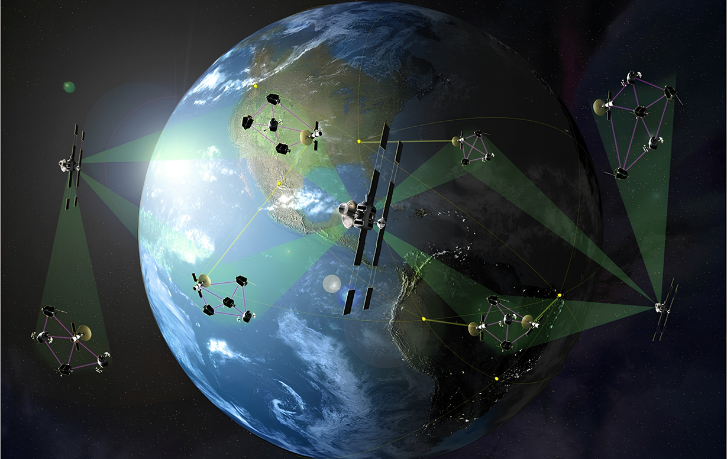
In July 2026, environmental and scientific organizations represented by Earthjustice asked the Federal Communications Commission to pause consideration of orbital data-center applications and conduct a programmatic environmental review under the National Environmental Policy Act. The applications contemplate well over one million satellites in low-Earth orbit. The FCC has not granted the petition, paused the applications or adopted a proposed exclusion of space operations from NEPA review.
The petition argues for examining potential cumulative effects involving launches, satellite reentries, orbital debris, light pollution and astronomy, rather than reviewing each proposed constellation separately. That system-level approach is significant because the contemplated scale is not an incremental extension of present licensing practice. A Secure World Foundation discussion of pending concepts identified plans including a one-million-satellite system, an 88,000-satellite system, a constellation of up to 51,600 satellites and another with 20,000 satellites.
One architecture, multiple federal actions
The petition arrives as federal policy is moving in a different direction. In 2025, the FCC proposed excluding space-based operations from NEPA review on the stated basis that the activities and their effects occur entirely outside U.S. jurisdiction. The commission also requested comment on whether some space operations or effects occur within U.S. jurisdiction. Historically, it has treated satellite licensing as categorically excluded from environmental review unless circumstances warrant additional consideration.
That leaves two distinct questions. The first is whether an FCC decision authorizing satellite operations triggers NEPA when the licensed activity occurs in space. The second is which environmental effects are sufficiently connected to that FCC action, rather than to a separate federal approval.
Commercial launches and reentries fall under Federal Aviation Administration licensing authority. The FAA’s environmental-document library illustrates how its reviews are normally defined around particular licensing actions: individual reentry vehicles, specified landing or splashdown areas, launch-site operations and changes in annual launch cadence. Those project boundaries differ from an FCC review centered on communications and orbital operations.
The distinction matters technically as well as legally. A large orbital system can be designed and described as an integrated architecture, but federal agencies may authorize it through separate decisions. Launch emissions or recovery operations are therefore not automatically effects of an FCC satellite license merely because the satellites depend on launches. Conversely, treating every application as isolated could make it difficult to assess effects arising only when many constellations occupy the same orbital environment.
Courts have supplied arguments, not a settled answer
The D.C. Circuit’s decision in Environmental Defense Fund Inc. v. Massey offers possible support for applying NEPA to a domestic agency decision involving activity beyond U.S. territory. That case concerned a National Science Foundation decision about food-waste incineration at a U.S. research station in Antarctica. The court focused on federal decision-making in the United States and the absence of another nation’s recognized sovereignty over Antarctica.
Outer space is likewise not subject to national appropriation through sovereignty claims under the Outer Space Treaty, but the comparison does not settle whether an FCC satellite authorization requires the review sought here. The regulated activities, statutory authorities and potentially connected effects differ.
The Supreme Court’s 2025 decision in Seven County Infrastructure Coalition v. Eagle County adds another boundary. It emphasized effects attributable to the project under review rather than an open-ended examination of separate upstream or downstream projects. It also stressed judicial deference to agencies over the scope and detail of environmental analysis. Applied to orbital infrastructure, that reasoning could make the definition of the licensed project decisive.
The FAA is simultaneously considering a separate proposal to waive requirements under NEPA and 12 other federal laws for certain commercial-space licenses and permits. The July 30 proposed rule has not been finalized. It underscores the unresolved coordination problem: reducing overlap may accelerate approvals, but dividing one architecture among narrow agency actions can also leave uncertainty over who accounts for cumulative system effects.
For U.S. developers, the outcome could shape application structure, environmental documentation and early architecture choices for communications constellations, in-space manufacturing and satellite servicing not just orbital data centers. At million-satellite scale, the decisive policy question may be less about where space begins than where each agency’s project legally ends.
| More aerospace and engineering stories, right in your MSN feed. Follow AMI on MSN |
By Thomas Caldwell — AMI’s senior editor for mechanical and mobility engineering, covering vehicle electronics, systems integration, electrification, chassis systems, propulsion, and safety policy.