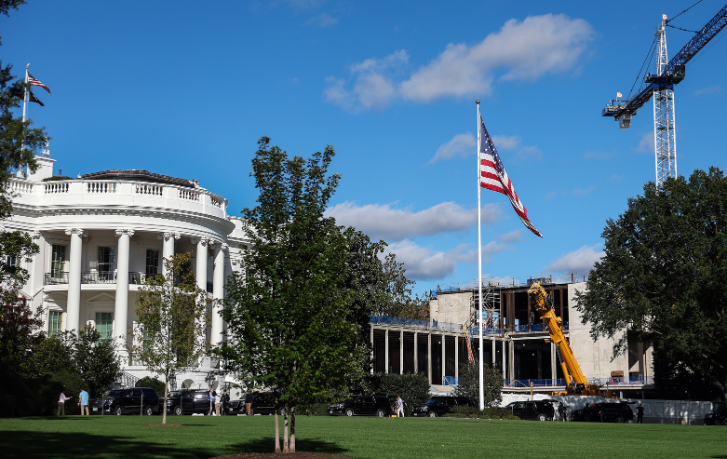
White House Ballroom Records Show $333 Million Network, $77 Million Anonymous
Internal fundraising records identify $333 million in private commitments for the White House ballroom project, including $25 million each from Nvidia and Apple. The records also indicate that donors seeking anonymity supplied at least $77 million, leaving a substantial portion of the funding network hidden from public view.
The spreadsheet lists the source, date and amount of 67 donations above $10,000 recorded through late September 2026. More than three-quarters of the total was pledged in commitments of at least $5 million. Nvidia, Apple, the Adelson family and Dish Network co-founder Charles Ergen made the four largest documented commitments at $25 million apiece.
That concentration is central to the public-accountability question. Companies or executives associated with federal contracts during President Donald Trump’s second term accounted for about half of the money, according to The Washington Post’s analysis. Nvidia said its support was independent of its business interests, while Nvidia and Cisco separately confirmed multimillion-dollar commitments.
How the private money enters a federal project
The donations do not move directly from each contributor into an ordinary congressional appropriation. They are collected through the nonprofit Trust for the National Mall, which channels the funds to the government and a White House account controlled directly by the president. A government agreement requires the Trust to preserve donor anonymity to the extent permitted by law.
The Trust said anonymous philanthropy is common and that it honors requests for confidentiality. Nvidia requested anonymity for its $25 million commitment, according to the internal documents. That arrangement creates a transparency gap because contributors can have contracts, regulatory matters or other federal interests even when their identities and individual amounts are absent from the White House’s public disclosures.
The White House publicly named 37 donors in October 2025 but did not provide their individual donation amounts. Trump was not listed in the obtained spreadsheet, despite saying after demolition of the old East Wing began that the project was being paid for entirely by him and friends. The $333 million committed remained below his stated $400 million fundraising target.
The financing also sits within a larger construction program. The broader East Wing project including the ballroom, office space and an underground military facility had a reported projected cost of $600 million, and taxpayer money has covered some construction costs. For critics focused on spending and access, the immediate concern is therefore not only a roughly $330 million pool of ballroom commitments, but that about half came from companies and executives associated with federal contracts.
Timing raises questions but does not establish an exchange
Some entries show donations near consequential government actions. Isabela Herrera pledged $2.5 million in September 2025 and paid an initial $835,000 installment on October 14. Her father, international banker Julio Herrera Velutini, had reached an August 2025 plea agreement that reduced federal bribery charges to a misdemeanor. Trump issued him a full and unconditional pardon in January 2026.
The timing invites scrutiny, but the reporting did not establish that Herrera’s commitment produced the pardon. The documented facts show a donation followed months later by presidential clemency, not a proven agreement connecting the two.
Ergen’s $25 million was divided into two $12.5 million commitments, made in December 2025 and February 2026. The Federal Communications Commission had ended an investigation of EchoStar before the first commitment. The FCC and Justice Department subsequently approved a sale of EchoStar licenses. Here too, the chronology identifies overlapping private and federal interests without establishing that the contribution caused favorable action.
Cryptocurrency companies and investors promised more than $18 million. That included bitcoin valued at $5,050,018 from Tyler and Cameron Winklevoss. A separate claim that Google settlement funds supplied $22 million has not been independently verified and is not treated as part of the documented donor breakdown.
White House spokesman Davis Ingle rejected conflict-of-interest allegations, arguing that critics would also object if taxpayers financed the renovations. He said the administration would pursue those responsible for leaking the records while protecting donors. That response leaves the underlying governance issue unresolved: a major addition to a federal landmark is being financed through a system designed to accept large private commitments while preserving substantial donor anonymity.
| More aerospace and engineering stories, right in your MSN feed. Follow AMI on MSN |
By Thomas Caldwell — AMI’s senior editor for mechanical and mobility engineering, covering vehicle electronics, systems integration, electrification, chassis systems, propulsion, and safety policy.