David Rule Builds Eight-Foot Tinytanic Houseboat to Fit a Pickup Bed
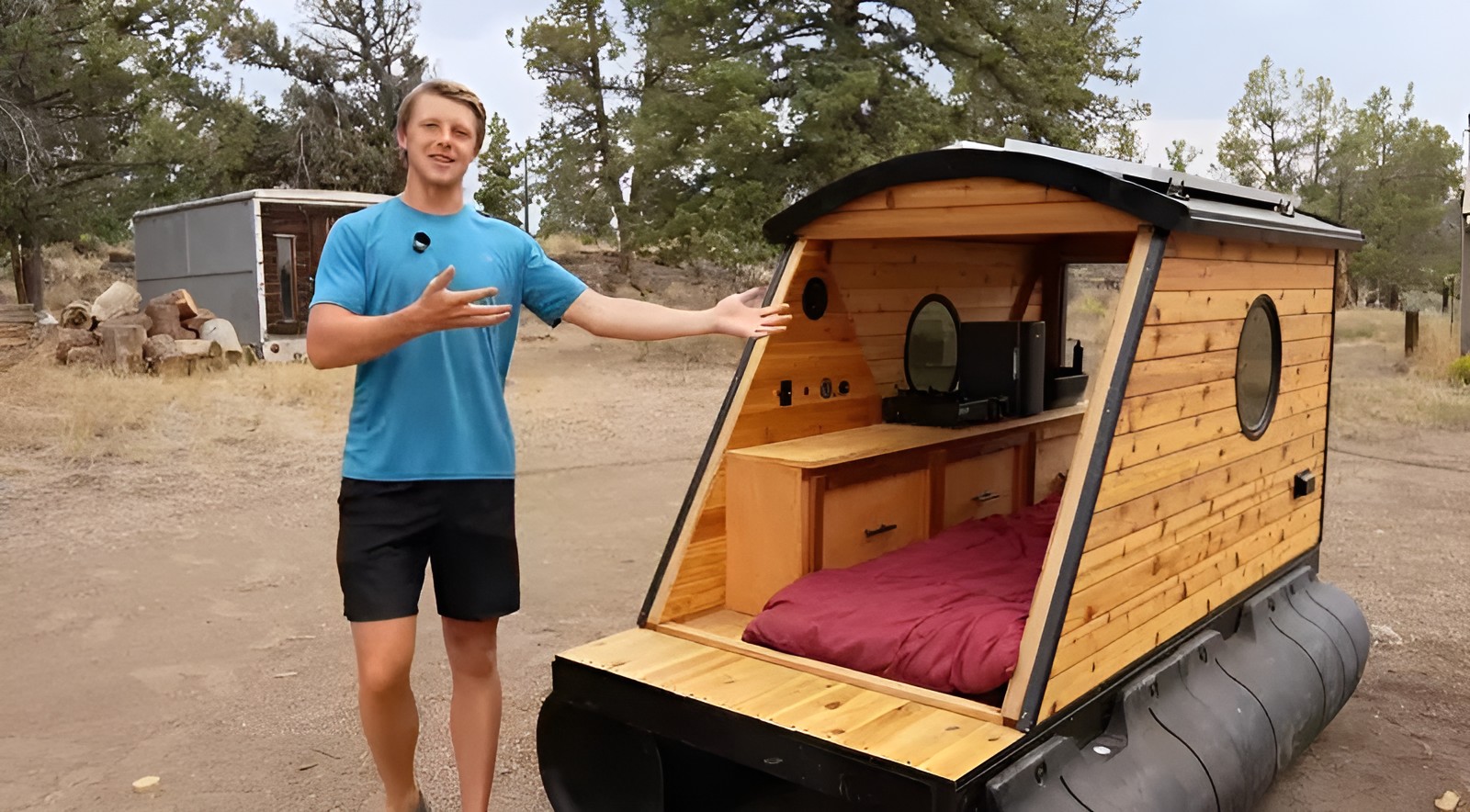
Eight feet long and 3.5 feet wide: that is the footprint David Rule used for the Tinytanic, a completed micro-houseboat described as small enough to load into a standard pickup bed. Within that space, Rule fitted a bed, an operational kitchen, refrigeration and an electrical system supported by solar power.
The surprising result is not merely a short hull. It is the concentration of several basic cruiser functions into a vessel occupying roughly 28 square feet when measured by overall length and width. Each function competes for the same limited volume, payload allowance and access space, turning the Tinytanic into a compact systems-integration exercise.
Multiple living systems share one small envelope
A bed is relatively simple by itself, but its placement affects movement through the cabin and access to equipment. A kitchen needs usable work space and secure storage, while refrigeration adds electrical demand and requires room for the appliance and associated wiring. Solar support introduces more components, potentially including panels, charge-control hardware, energy storage and electrical protection, although the configuration and capacity of Rule’s system have not been specified.
Those functions also influence one another. Electrical equipment must coexist with cooking and water-related areas inside a narrow enclosure. Added high-mounted equipment can affect weight distribution, while batteries, appliances and interior structures consume payload that otherwise could be allocated to people and supplies. The build’s dimensions therefore establish its packaging achievement, but they do not disclose the vessel’s usable load or operating envelope.
The American Boat & Yacht Council’s latest small-craft standards supplement illustrates the breadth of the integration work involved in a boat with domestic-style equipment. Its updated subjects include alternating- and direct-current electrical systems, lithium-ion batteries, battery chargers and inverters, water systems, drainage, fuel systems and carbon-monoxide detection. The available information about the Tinytanic does not identify its battery chemistry, cooking-energy source, wiring architecture or water arrangement, so compliance with any particular standard cannot be assessed.
Pickup-bed portability needs more than dimensions
Designing around an eight-foot length makes pickup transport plausible, but dimensional fit is only one part of portability. The Tinytanic’s weight, center of gravity, lifting points and loading method have not been provided. Nor has the pickup used to demonstrate the fit been identified. Those details determine whether loading requires separate equipment, how the vessel can be restrained during road transport and what payload capacity the carrying truck needs.
Width deserves similar attention. At 3.5 feet, the vessel is narrow enough to occupy a compact transport envelope, but a narrow hull carrying a cabin, appliances and occupants requires verified stability and buoyancy characteristics. No stability results, passenger capacity, hull material, propulsion arrangement, maximum load or water-condition limits have been disclosed.
Formal small-craft evaluation offers a useful reference point for the questions that remain. ISO 12217-1:2022 covers methods for assessing intact stability, buoyancy and swamping characteristics for certain non-sailing boats. It principally applies to craft from six to 24 meters long, although it can apply to some boats under six meters under defined conditions. At eight feet, the Tinytanic is far below the standard’s principal length range, and the available details are insufficient to determine which assessment route would apply.
Accommodation does not establish operating performance
Rule has called the Tinytanic the world’s smallest houseboat, but no independent survey or global comparison has been provided to establish that record. Its documented distinction is more specific and more useful: it combines sleeping, cooking, refrigeration and solar-supported electricity within an eight foot by 3.5-foot package described as fitting a pickup bed.
Basic boating requirements remain independent of cabin size or novelty. The U.S. Coast Guard says a recreational vessel must carry an approved wearable personal flotation device for every person aboard, with the devices readily accessible. Passenger capacity has not been stated for the Tinytanic, making occupancy one of several important limits still needing definition.
The finished vessel demonstrates that several houseboat functions can be physically compressed into a pickup-portable footprint. Weight, loading procedure, electrical architecture, stability, buoyancy and operating limits will determine whether that packaging concept also translates into a clearly defined and repeatable small-craft system.
| More aerospace and engineering stories, right in your MSN feed. Follow AMI on MSN |
By Thomas Caldwell — AMI’s senior editor for mechanical and mobility engineering, covering vehicle electronics, systems integration, electrification, chassis systems, propulsion, and safety policy.