USS Theodore Roosevelt Reportedly Brings Third Carrier to Central Command Region
Three U.S. aircraft carriers are reportedly inside U.S. Central Command’s region, but the striking number may describe a handover more than a lasting buildup. USS Theodore Roosevelt’s carrier strike group entered the command’s area of responsibility on November 15, 2026, ABC News reported, citing a U.S. official.

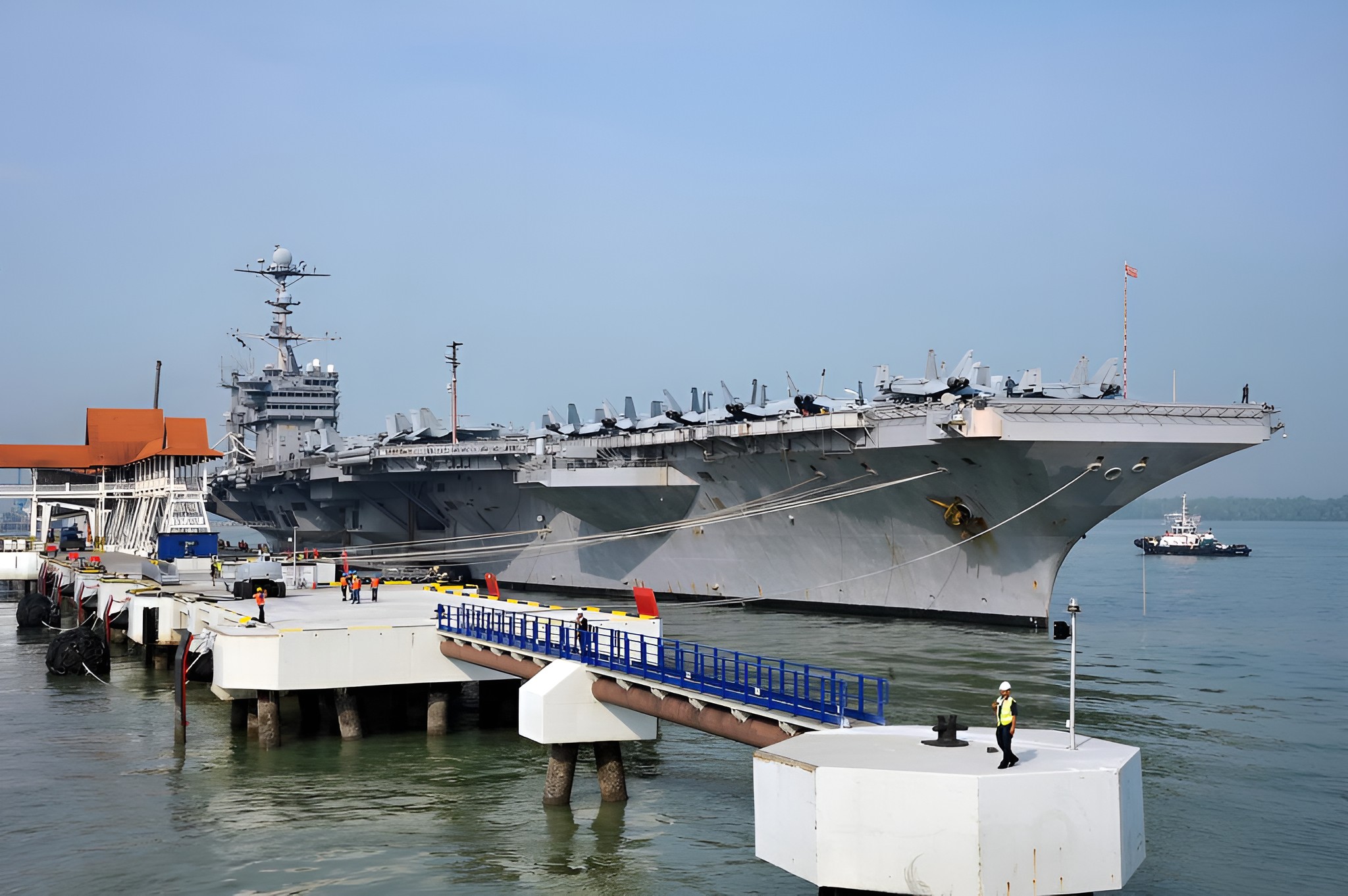
The arrival temporarily places Theodore Roosevelt alongside carrier groups centered on USS George H.W. Bush and USS George Washington during the confrontation with Iran. It gives regional commanders another mobile flight deck and carrier air wing, expanding the aviation capacity available for defensive patrols, surveillance, maritime security, airborne early warning, electronic warfare and other missions ordered by commanders.
Theodore Roosevelt had been expected to relieve George Washington, however. The overlap could end when the outgoing carrier departs rather than become a sustained three-carrier posture. Available reporting has not established how long all three will remain in the region or whether George Washington’s departure schedule has changed.
Another flight deck adds flexibility, not fixed output
An additional carrier can make a meaningful operational difference even when the ships are not working together. Aviation missions can be distributed among groups, allowing one carrier to maintain coverage while another replenishes, conducts maintenance, repositions or prepares to leave.
That flexibility is broader than adding another set of fighters. USNI News identified Carrier Air Wing 11 as embarked aboard Theodore Roosevelt during its November transit. The Navy describes the wing as comprising nine squadrons operating F/A-18E/F Super Hornet fighters, EA-18G Growler electronic-warfare aircraft, E-2D Hawkeye airborne command and control aircraft, V-22 Ospreys and MH-60R/S Seahawk helicopters.
That published organization describes the types of aircraft assigned to the wing, not the exact number or readiness of aircraft currently aboard. A carrier air wing’s usable output depends on aircraft serviceability, available flight crews, maintenance personnel, weapons stocks, weather, flight schedules and distance from its assigned operating areas.
For that reason, a three-carrier count cannot be converted into a proportional increase in missions. One additional deck may provide more scheduling room and redundancy, but the practical gain varies by mission and by the readiness of each ship and air wing. Presence inside Central Command’s broad area also does not mean the three carriers are operating together or equally close to Iran.
The overlap carries a readiness cost
The reported concentration arrives as the Navy is already managing unusually long deployments. Navy leaders said in October that sailors should expect deployments of roughly 10 to 11 months for the next couple of years, rather than the more typical seven months. Longer deployments can disrupt maintenance and availability cycles after ships return home.
That constraint is built into carrier force generation. A carrier must move through maintenance, training and deployment phases with its crew, air wing and supporting ships prepared on compatible schedules. The Navy can extend deployments or adjust rotations to preserve regional coverage, but those decisions move pressure elsewhere in the cycle.
A Government Accountability Office review of Navy fleet-response maintenance found that greater carrier availability relies on managing maintenance continuously rather than eliminating major repair requirements. The older review predates the current deployment, but the underlying systems constraint remains relevant: forward presence consumes readiness that must eventually be restored through maintenance, training and crew recovery.
Theodore Roosevelt’s arrival therefore gives commanders another flight deck during a consequential period, while leaving the duration and scale of the increase unresolved. The clearest next indicator will be whether George Washington departs as expected. Until then, the three-carrier presence is best understood as expanded capacity during a rotation not confirmation of a permanent buildup or authorization for additional attacks.
| More aerospace and engineering stories, right in your MSN feed. Follow AMI on MSN |
By David Whitaker — Associate editor for AMI’s aerospace and drone systems desk, translating flight systems, aircraft programs, spaceflight, and UAV developments into accessible technical stories.