Vulcan Fails to Put 40 Amazon Leo Satellites Into Orbit
United Launch Alliance’s Vulcan rocket failed to place 40 Amazon Leo broadband satellites into orbit on November 15, ending the first of 38 contracted Vulcan missions without its planned deployment. The failure leaves Amazon’s intended sequence of follow-on launches dependent on an investigation, corrective action and authorization for Vulcan to fly again.

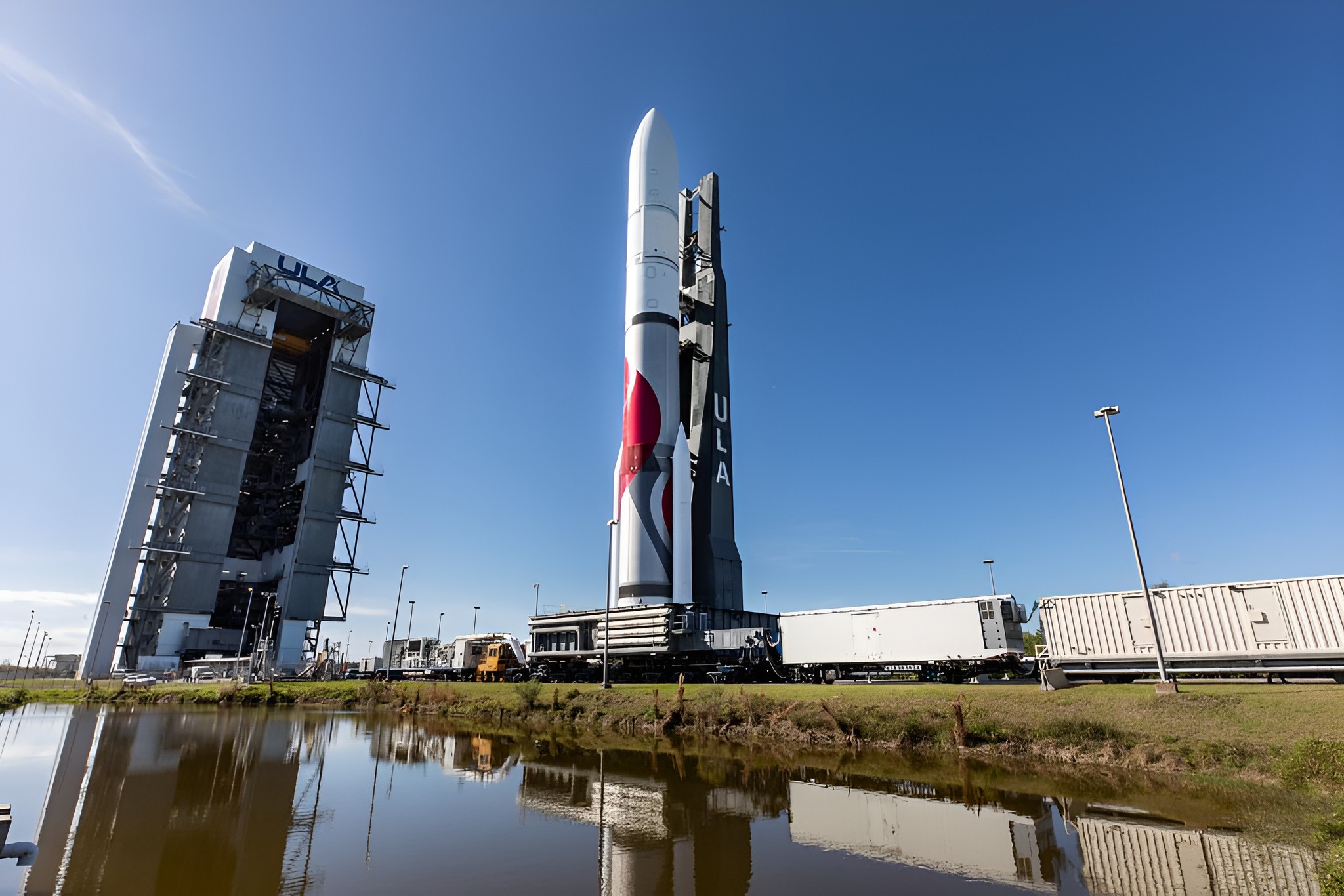
The rocket lifted off from Cape Canaveral Space Force Station at 17:40 UTC. ULA reported an anomaly about 10 minutes into the flight and said in an update at 18:31 UTC that it did not yet have specific data explaining what occurred. The company plans to work with Amazon and other appropriate organizations to identify the cause and determine the changes needed for a return to flight.
What Vulcan completed before the anomaly
The confirmed flight milestones narrow where investigators will look without identifying a failed component. Vulcan’s six solid rocket boosters burned out and separated one minute and 45 seconds after liftoff. At about six minutes, ULA confirmed separation of the rocket’s core stage, ignition of the Centaur V upper stage and jettison of the payload fairing.
At that point, the vehicle was 95 miles high and traveling faster than 11,000 mph east of Charleston, South Carolina. Those events place the anomaly after the initial boost phase and after Centaur V operations had begun. They do not establish whether the upper stage, another vehicle system or a different issue caused the mission failure.
This mission also introduced Vulcan’s VC6L configuration. It combined six strap-on boosters with two methane-fueled BE-4 main engines and a shorter Centaur V optimized for low Earth orbit. The upper stage used two RL10C-1-1A engines. Because this was the first flight of both the six-booster arrangement and the shorter upper stage, investigators will have configuration-specific flight data to examine alongside telemetry from Vulcan’s earlier missions.
The investigation now controls the launch schedule
A failed commercial launch falls within a formal safety and licensing process, not only an internal engineering review. The Federal Aviation Administration’s mishap framework says a failure to complete a launch as planned can qualify as a mishap. The operator is responsible for preserving data and evidence, reporting the event and investigating its root cause, with FAA oversight when applicable.
Returning to flight does not always require the entire investigation to be closed. An operator can request permission to resume launches earlier if it identifies and implements preventive measures and demonstrates that public-safety risks are acceptably controlled. Otherwise, the FAA can review the final investigation report and its corrective actions before operations restart. The available information does not yet establish which path or timeline will apply to Vulcan.
That uncertainty reaches beyond a single payload. Amazon selected Vulcan to carry more than 1,500 first-generation satellites for an initial Leo constellation planned to exceed 3,000 spacecraft. Melissa Wuerl, Amazon Leo’s director of launch systems, had described the rocket as the constellation’s “primary workhorse over the next several years.” ULA previously completed eight Amazon deployment missions using Atlas V, but LV-01 was Amazon’s first mission on its successor.
Infrastructure cannot bypass a grounded rocket
Amazon funded new infrastructure at Cape Canaveral to support the planned tempo, including the VIF-A vertical integration facility and a mobile launch platform. The added processing capacity was intended to let ULA prepare two Vulcan missions simultaneously and shorten turnaround times to days or weeks.
That investment addressed a ground-processing constraint: how quickly hardware could be assembled and moved toward launch. It cannot remove the need to understand an in-flight anomaly and validate the resulting corrective action. A second Amazon mission, LV-02, was already being prepared and had been expected to launch within weeks if LV-01 performed nominally.
Amazon has launch agreements with Arianespace, Blue Origin, SpaceX and ULA, giving the constellation multiple launch providers. Vulcan nevertheless carries the largest stated assignment in the program, with 38 contracted flights expected to deploy more than 1,500 satellites. Until investigators establish what happened after the confirmed start of Centaur V operations, the infrastructure built for rapid Vulcan turnarounds will be waiting on the slower and more consequential task of clearing the rocket to fly again.
| More aerospace and engineering stories, right in your MSN feed. Follow AMI on MSN |
By David Whitaker — Associate editor for AMI’s aerospace and drone systems desk, translating flight systems, aircraft programs, spaceflight, and UAV developments into accessible technical stories.