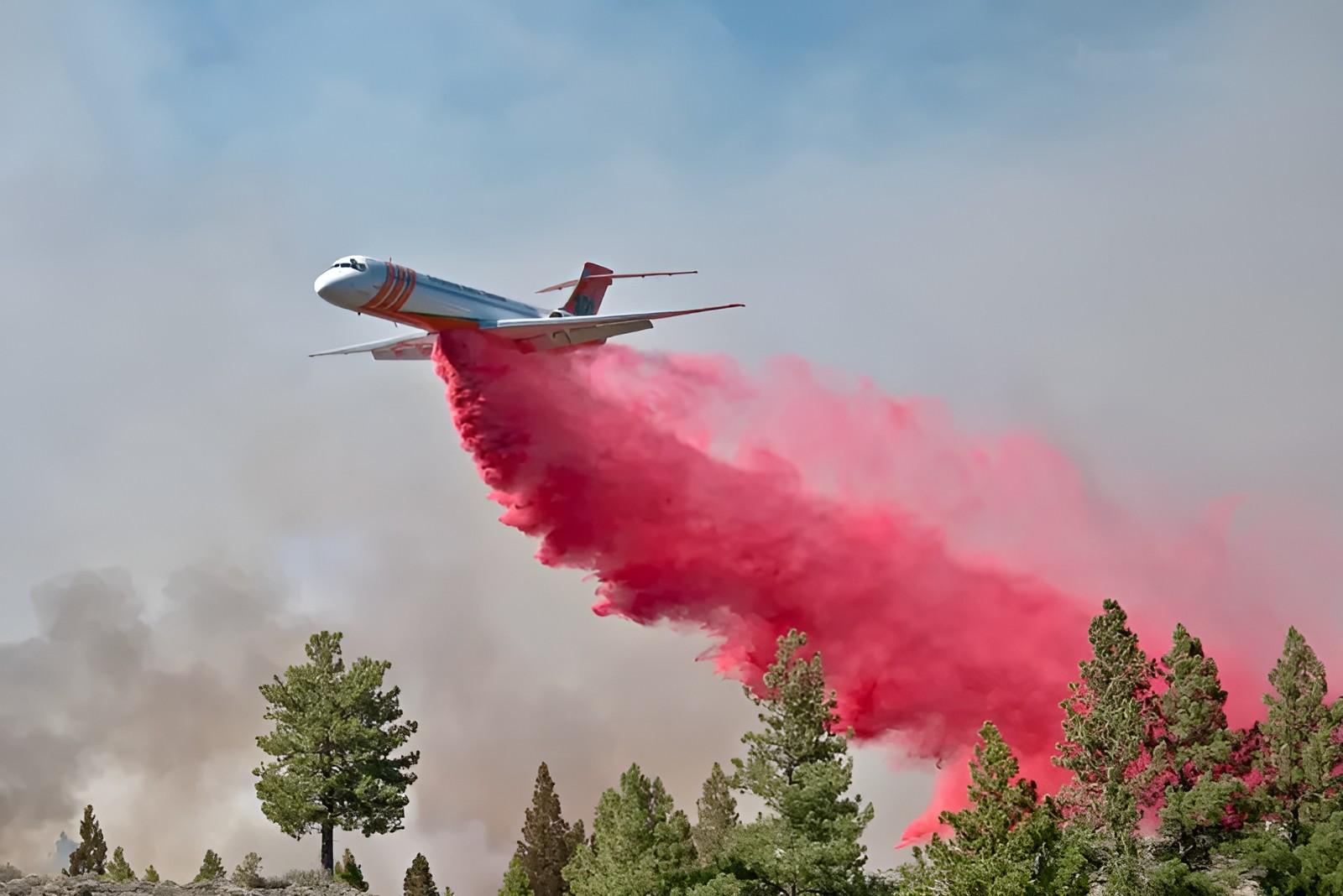
NTSB Urges Stronger Tests After Retardant Corrodes Two Airtankers
A firefighting retardant passed the U.S. Forest Service’s qualification process, yet it was linked to extensive corrosion on two large airtankers within one 2023 fire season. The National Transportation Safety Board is now urging the Forest Service to strengthen its corrosion tests after investigators found damage to structural, control, electrical, tank and engine components.
The most consequential finding was on an MD-87 operated by Aero Air. Corrosion penetrated more than half the thickness of a wing spar doubler classified as primary structure. A British Aerospace BAe-146 operated by Neptune Aviation Services also developed extensive corrosion during the evaluation of Fortress FR-200, a magnesium chloride-based retardant.
The qualification tests missed the aircraft-level problem
The investigation points to a gap between testing a chemical against individual materials and testing it against an aircraft as an assembled system. Forest Service qualification procedures relied mainly on isolated metal samples, according to the NTSB, and did not adequately reproduce the combinations of materials found in aircraft construction.
That distinction changes what a corrosion test can reveal. An airtanker is not a collection of separate coupons exposed under uniform laboratory conditions. Retardant can reach structures, connectors, cables, tank hardware and engine materials that differ in composition, coatings, geometry and exposure. Interfaces between components can retain contamination or create conditions unlike those represented by a single exposed sample.
The evaluation conducted before FR-200 received full qualification also used a single-engine airtanker equipped with a fiberglass retardant tank. That configuration did not represent the metallic tank structures and broader material combinations encountered in the two large airtankers that subsequently carried the product.
The BAe-146 and MD-87 initially carried FR-200 exclusively and later alternated between FR-200 and a phosphate-based retardant. Follow-up testing found that FR-200 could cause corrosion by itself. It also found that interactions between FR-200 and phosphate-based products could increase corrosion under certain conditions. The qualification problem therefore involved both the retardant’s individual effects and operating exposures that could place different formulations into the same aircraft over time.
Realistic testing must include combinations and repeated exposure
A stronger qualification program would need to capture the conditions identified by the investigation rather than merely add more samples of the same type. At minimum, the test design would need to represent combinations of aircraft materials and the potential interaction between retardant formulations. It would also need to account for the fact that corrosion developed over a single operating season, making exposure sequence and duration relevant to whether a product remains compatible with an aircraft in service.
The distribution of the damage also argues for a system-level assessment. Corrosion was found on structural components, electrical connectors, flight-control cables, retardant-tank components and engines. Those are different aircraft functions with different inspection access and consequences. A qualification method focused too narrowly on visible tank surfaces could overlook deterioration in less accessible locations or components outside the main containment system.
Detection is the second line of defense, not a substitute for representative qualification. The FAA’s aircraft corrosion-control guidance places inspection frequency, identification and treatment responsibilities on operators, working from manufacturer recommendations or approved maintenance programs. However, maintenance planning depends on knowing which materials and locations require attention. An exposure that was not adequately characterized before operational use can expand both the inspection burden and the area that maintainers must examine.
Corrosion removes material and can reduce the strength of metallic aircraft structure. The NTSB warned that undetected or uncorrected corrosion can result in structural failure. In the MD-87 finding, the loss of more than half the thickness of a primary-structure wing spar doubler provides a concrete measure of why compatibility testing cannot stop at whether a retardant performs its firefighting function.
The Forest Service has been asked to strengthen its requirements; adoption of the requested changes has not been established. The next important step is whether qualification testing is revised to represent complete aircraft material systems, realistic exposure histories and possible interactions between retardants before another product enters fleet use.
| More aerospace and engineering stories, right in your MSN feed. Follow AMI on MSN |
By Thomas Caldwell — AMI’s senior editor for mechanical and mobility engineering, covering vehicle electronics, systems integration, electrification, chassis systems, propulsion, and safety policy.