Russia Sent Two Nuclear-Capable Tu-95 Bombers to Vietnam, Triggering Regional Alerts
Two Russian Tu-95 strategic bombers capable of carrying nuclear-armed cruise missiles reached Da Nang, Vietnam, after a long-range flight that prompted responses from Japan, South Korea and Taiwan. The aircraft were accompanied by two Il-78M support planes, giving the deployment the aerial-refueling capacity needed to sustain strategic aircraft far from their home base.

Satellite imagery showed all four Russian aircraft at Da Nang International Airport at 03:16 UTC on November 17. Open-source aviation analyst AviVector identified the bombers as RF-94202 and RF-94188 and reported that the group had arrived from Ukrainka Air Base in Russia’s Amur region. The aircraft subsequently left Vietnam on November 19, according to an Associated Press update.
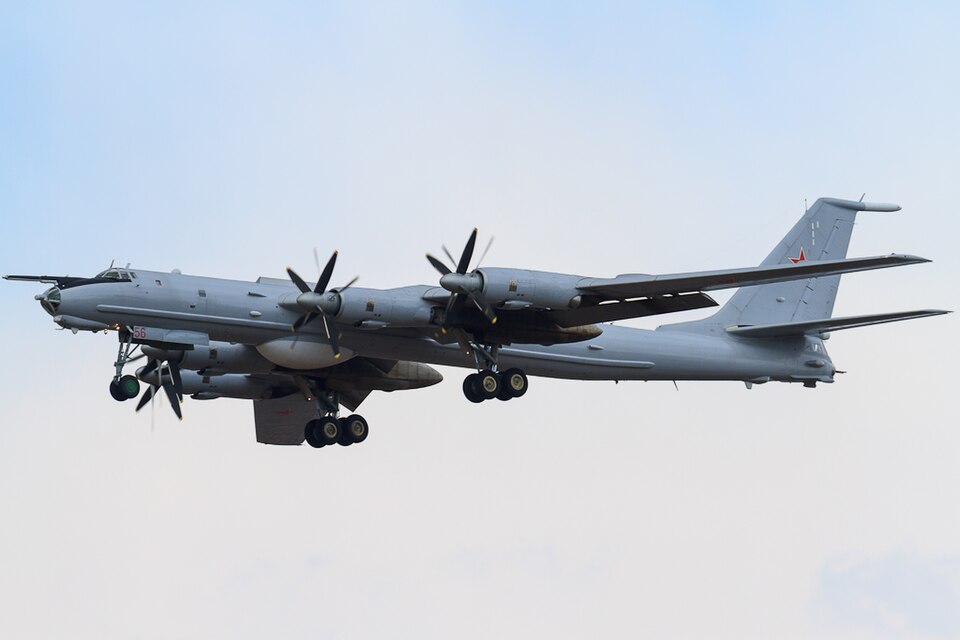
The deployment put two of Russia’s best-known strategic aircraft in Southeast Asia for a short but conspicuous visit. The Soviet-designed Tu-95MS, called the Bear by NATO, is a long-range turboprop bomber designed to carry cruise missiles. Some of those weapons can carry nuclear warheads, which makes the aircraft nuclear-capable. No information released about the Vietnam deployment establishes that nuclear weapons were aboard.
That distinction leaves the operational significance in the movement of the aircraft rather than any confirmed payload. Russia demonstrated that it could send a pair of strategic bombers from its Far Eastern infrastructure to Vietnam with tanker support, keep the formation moving across a heavily monitored region and recover the aircraft after the visit.
Regional authorities tracked the flight
The trip generated different types of air-defense responses along the route. Japan’s Ministry of Defense reported that two aircraft believed to be Russian briefly entered Japanese territorial airspace northwest of Okinoshima Island in Fukuoka Prefecture. Japan scrambled fighters and issued warnings; Japanese authorities said the violation lasted about five minutes.
South Korea also scrambled fighters after several Russian military aircraft entered its air defense identification zone over waters between the Korean Peninsula and Japan. South Korean authorities said the aircraft did not enter the country’s national airspace.
Taiwan reported two Russian military aircraft passing through its air defense identification zone east of the island during the deployment. After the bombers left Vietnam, Taiwan’s Defense Ministry said it tracked two Tu-95 aircraft approaching from the south and flying past the island’s eastern coast.
An air defense identification zone is not the same as sovereign airspace. Such zones extend into international airspace and are used to identify aircraft approaching a country. The U.S. Naval War College’s International Law Studies describes an ADIZ as designated airspace in which aircraft may be expected to follow identification or reporting procedures. Entering one can trigger monitoring or an intercept without constituting a territorial-airspace violation. Japan’s reported encounter was therefore the more serious airspace event on this flight.
Tankers extended the deployment’s practical reach
The two Il-78M aircraft were a central part of the formation. Aerial-refueling support gives long-range bombers more flexibility in routing, endurance and recovery planning than the bombers would have operating alone. It also adds maintenance and coordination demands: four large aircraft must be supported at the destination, while tanker availability becomes part of the mission’s overall readiness requirement.
Ukrainka is a major strategic-aviation base in Russia’s Far East, approximately 5,400 kilometers from Engels Air Base in western Russia. Reports cited in connection with the deployment indicated that 37 Tu-95MS bombers and 10 Tu-160 bombers had been concentrated at Ukrainka in early November. Those reported numbers provide context for why the Amur-region base could support a Pacific-oriented mission involving multiple strategic and support aircraft.
AviVector described the visit as the first reported Russian military-aviation deployment to Vietnam since 2014, when Il-78 refueling aircraft operated from Cam Ranh. This time, the tankers did not arrive alone: two strategic bombers reached Da Nang with them. Their nuclear-capable design raised the profile of the visit, but the verified operational result was narrower and still consequential a tanker-supported Russian bomber deployment into Southeast Asia that activated air-defense monitoring across three regional jurisdictions.
| More aerospace and engineering stories, right in your MSN feed. Follow AMI on MSN |
By David Whitaker — Associate editor for AMI’s aerospace and drone systems desk, translating flight systems, aircraft programs, spaceflight, and UAV developments into accessible technical stories.