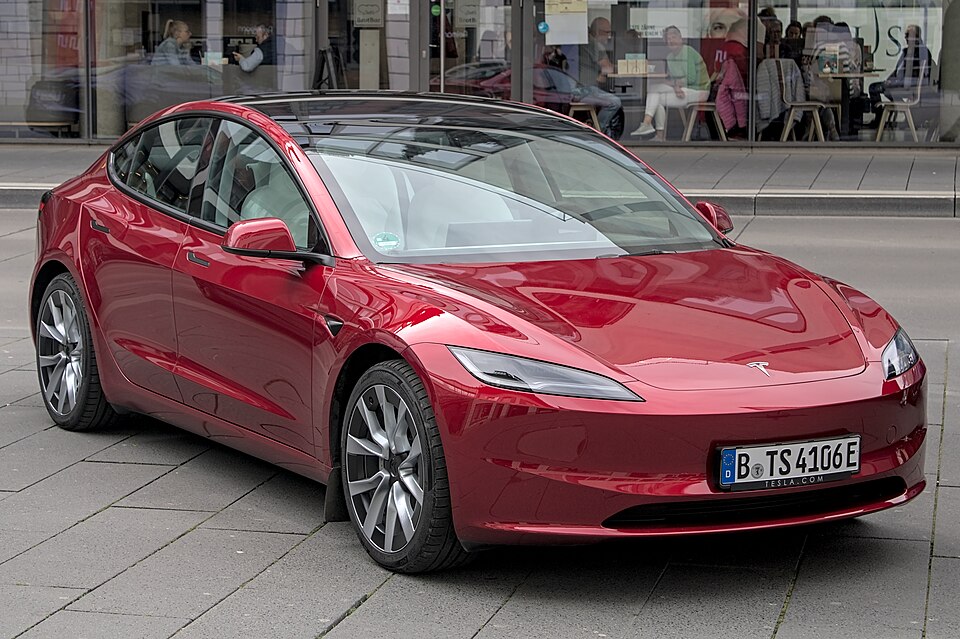
300,000-Mile Tesla Model 3 Keeps 86% Battery Health, Barely Wears Brakes
A Tesla Model 3 Standard Range in Australia reportedly retained 86% of its original battery health after nearly 300,000 miles, while its front brake pads lost only one millimeter of material. Yet the same car needed repeated suspension repairs as well as work on its air-conditioning and drive systems an unusually clear example of how durability can diverge among systems in one electric vehicle.

The car accumulated nearly half a million kilometers, or roughly 300,000 miles, during about five years of heavy use. At a roadworthiness inspection, its front pads reportedly measured nine millimeters thick. Tesla’s Model 3 brake specifications list 10 millimeters as the new thickness for non-performance front pads and 2.8 millimeters as the service limit. On those figures, the inspected pads remained far from their replacement threshold.
Regenerative braking changes the wear pattern
The owner attributed the limited pad wear to one-pedal driving. When the driver lifts off the accelerator, the traction motor can act as a generator, converting some of the car’s kinetic energy into electricity while slowing the vehicle. The hydraulic friction brakes consequently do less of the routine deceleration work.
That division of labor helps explain how a car can cover extreme mileage without consuming brake pads at the rate expected in a conventional vehicle. It does not eliminate the friction brakes, which remain necessary for stronger stops and conditions in which regenerative braking is limited. Pad thickness also represents only one part of brake condition; the supplied inspection details do not provide equivalent measurements for the rear pads, rotors, calipers or brake fluid.
Still, the reported one-millimeter loss is a striking component-level result. It reflects the operating history of this particular car, including the owner’s careful use of one-pedal driving, rather than a guaranteed service life for every Model 3.
The original battery remained, but with less capacity
The car’s original lithium iron phosphate traction battery reportedly showed 86% state of health. In practical terms, that figure indicates an estimated 14% reduction from its original usable capacity, although the available account does not specify the diagnostic method or test conditions behind the measurement.
The result is notable because the car also relied heavily on Tesla’s Supercharger network. Fast charging is often treated as inherently destructive to an electric-car battery, but charging speed is only one variable. Battery temperature, time spent at high charge levels, depth of discharge, usage intensity and battery-management controls all affect degradation.
A technical overview relaying research from the National Renewable Energy Laboratory notes that DC fast charging can increase degradation under some conditions, but observed differences have sometimes been small relative to overall capacity loss. The charging-speed research summary also emphasizes temperature as an important factor. This Model 3 adds a high-mileage example, not a controlled comparison of charging methods or battery chemistries.
Long battery life did not mean a maintenance-free car
The strongest contrast lies beneath and around the battery. The suspension reportedly required repairs more than once. The air-conditioning system and some drive-unit components also had to be replaced. No repair costs, exact component list or replacement mileages were provided, so the total ownership burden cannot be calculated from this case.
Those repairs nevertheless complicate the common assumption that a durable battery makes the entire electric car durable. The traction pack, friction brakes, suspension joints, dampers, climate-control hardware and drive unit operate under different loads and age through different mechanisms. Regenerative braking can sharply reduce pad use, but it does not reduce every impact transferred through the chassis. Likewise, good battery capacity retention does not prevent wear in bearings, joints, seals, pumps or air-conditioning components.
Battery-electric vehicles can have lower maintenance requirements in aggregate. An Argonne National Laboratory analysis estimated their maintenance costs at 40% below those of internal-combustion vehicles. Fleet-level estimates, however, cannot predict which parts will need attention on an individual high-mileage car, particularly one driven nearly 300,000 miles in five years.
This Model 3’s most consequential result is therefore the split itself: the original battery reportedly remained serviceable and the front pads retained nine of their original 10 millimeters, while suspension, climate-control and propulsion hardware required significant intervention. At extreme mileage, whole-vehicle durability is determined by the combined repair history not by the condition of its most expensive component alone.
| More aerospace and engineering stories, right in your MSN feed. Follow AMI on MSN |
By Thomas Caldwell — AMI’s senior editor for mechanical and mobility engineering, covering vehicle electronics, systems integration, electrification, chassis systems, propulsion, and safety policy.