Artemis II Reentry Puts Orion Heat Shield to the Test
As NASA’s Artemis II astronauts prepare to make their way back to Earth after traveling around the moon, perhaps the most challenging engineering feat of the mission still lies ahead. As they descend through the atmosphere, Orion will be traveling at an estimated speed of up to 23,839 miles per hour before making a Pacific Ocean splashdown off Southern California near San Diego, rounding out a mission that lasted nine days, seven hours, and 36 minutes.

And although the homebound portion is undoubtedly exciting, that last leg of the mission represents far more than a spectacular end to an adventurous journey. Re-entry is where a deep-space mission’s design runs squarely against its physical constraints: velocity, heating, materials properties, guidance, and recovery. That leaves Artemis II’s crew-recovery architecture, particularly its heat shield, under the spotlight.
Mission Pilot Victor Glover made no bones about how critical this segment was to his team. When asked how long the astronauts had been training to prepare for their return to Earth, Glover responded by saying he’s been preparing for this part of the mission since he received his assignment to the mission in April of 2023. Additionally, when describing what re-entry was like, Glover said, “riding a fireball through the atmosphere.” That’s because, unlike a capsule returning from low Earth orbit (LEO), a lunar return capsule is coming back at a substantially higher velocity. That means heat protection is not a subsystem. Heat protection is, itself, the survival system that enables the atmosphere to remove energy.
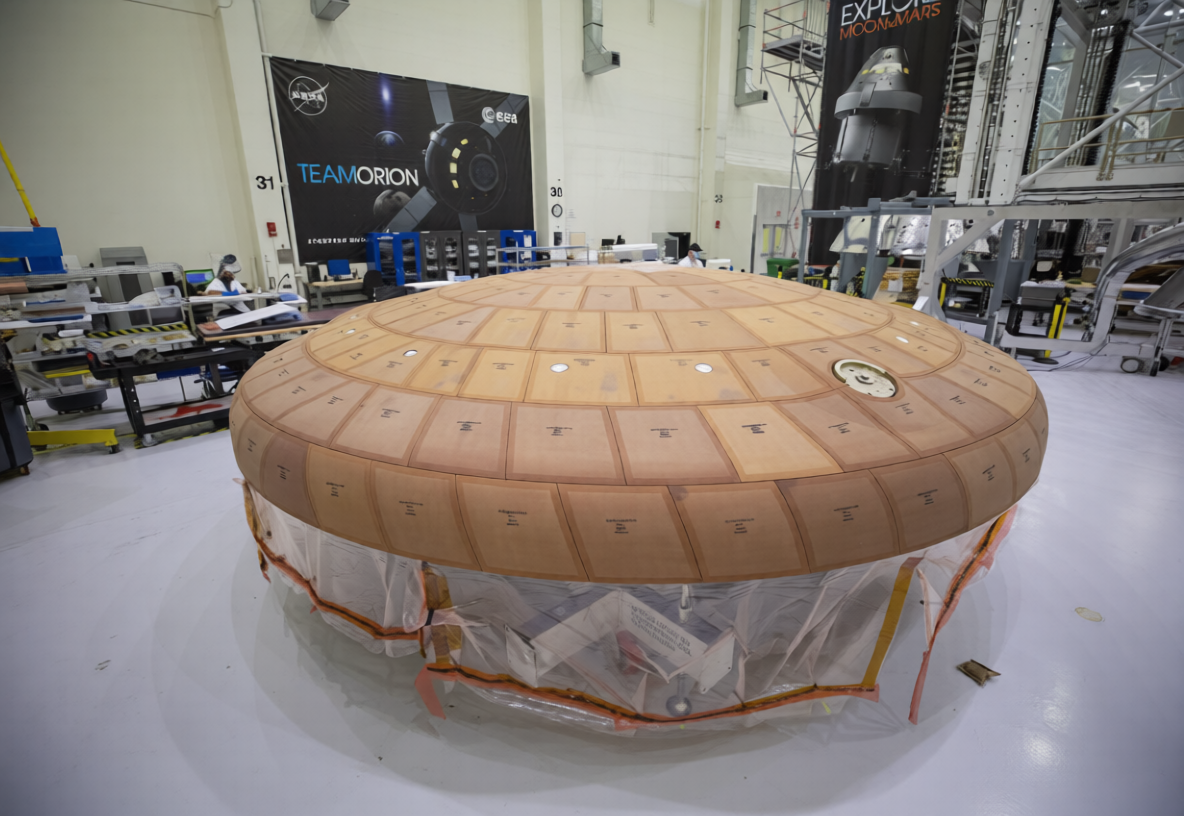
That makes Orion’s heat shield one of the most vital components of the entire Artemis II stack. According to NASA, Orion’s thermal protection system has undergone more than 1,000 arc-jet tests in advance of the mission. That involves subjecting test specimens to hot, high-velocity gas streams to replicate the intense heat of re-entry. Moreover, NASA said that data gathered during the Artemis I uncrewed moon flight informed a much wider certification process for crewed lunar return.
This previous flight has been crucial for shaping the Artemis II mission. As a result of post-Apollo I testing, NASA pinpointed the source of unexpected char erosion in Orion’s heat shield during its uncrewed lunar return mission. Researchers found that gases building up inside the Avcoat ablative material were not properly venting during portions of re-entry, resulting in cracking and uneven shedding of the material. While NASA said this would have left the Apollo I cabin environment safe for astronauts, the findings from the investigation certainly informed the risk assessment for the next mission as well as improving the heat-shield manufacturing process for subsequent flights.
To general readers, it is worth stating simply that Artemis II is not just a repeat of the Apollo-era show. Instead, it is part of a continuing development cycle wherein NASA is using data collected from an actual lunar re-entry to validate its modeling and improve its hardware.
This is relevant to Artemis II’s connection to the Artemis program as a whole. Specifically, the crew of Artemis II, comprised of Reid Wiseman, Victor Glover, Christina Koch, and Jeremy Hansen, is now a part of a four-person mission that traveled about 252,000 miles away from Earth and broke the previous distance record set by the Apollo 13 mission by more than 4,000 miles. More importantly, however, Artemis II marks yet another step forward for NASA’s crewed space transport capability.
Specifically, Christina Koch likened this mission to a relay race and said that her team actually purchased batons to symbolize passing on the baton of work to other missions. Practically speaking, though, the idea of passing on work translates to a relay of mission architecture. Artemis III will be the first crewed mission to include a docking test in LEO between Orion and the planned lunar landers. And in 2028, Artemis IV is set to become NASA’s first crewed lunar landing since Apollo 17 back in 1972.
Herein lies the importance of the sequencing of these Artemis missions. Successful exploration of the moon cannot simply rely on launching and operating a craft but requires integration over time. First, there needs to be a demonstration of the basic capability of launching, supporting crew in deep space, navigating to the moon on a free-return trajectory, surviving re-entry, and reliably recovering the craft. Only then can NASA safely add in other mission requirements, including docking capabilities and landing and surface operations that will help it establish a longer-term US presence on the moon within a decade.
Additionally, Artemis II itself has contributed some scientific knowledge to this program via live observations of the moon during both the outward-bound leg and the return. Specifically, in the course of their six-hour-long flyover, Artemis astronauts observed the moon, giving real-time feedback to dozens of scientists waiting in rooms adjacent to Mission Control in Houston.
In the meantime, the next objective for this mission remains re-entry itself. If the Orion spacecraft can demonstrate success throughout re-entry, descent, parachute deployment, and splashdown, Artemis II will prove a great deal more than having flown a highly visible mission that orbited the moon. Instead, the spacecraft will have successfully retired risk in one of the most challenging phases of human spaceflight and taken NASA one giant leap closer to subsequent and increasingly technically complex missions.
David Whitaker – Aerospace and drones system associate editor at AMI, turning flight systems, aircraft programs, spaceflight, and UAV systems into readable engineering stories.