California Energy Commission Approves 2029 Tire Rules Amid Price, Choice Concerns
California has approved a measurable reduction in the energy lost through replacement tires, but the cost of achieving it remains disputed. The California Energy Commission unanimously adopted the nation’s first replacement-tire efficiency standards on August 17, 2026. The new requirements begin in 2029, potentially lowering gasoline and electricity consumption while changing the prices and products motorists encounter at tire shops.
The rules cover replacement tires sold for passenger vehicles and light-duty trucks in California. Beginning in 2029, covered tires must meet a maximum rolling-resistance level of 9.1 newtons per kilonewton. That limit tightens to 7.2 in 2033. The commission says the program will make replacement tires at least as energy-efficient, on average, as tires originally installed on new vehicles.
Why rolling resistance affects energy use
A tire continuously deforms as it enters and leaves the road-contact patch. Some of the energy used in that deformation is dissipated as heat rather than returned to the vehicle. Rolling resistance measures the force the powertrain must overcome to keep the tire moving; a lower coefficient means less energy is lost for a given load.
That matters to gasoline and electric vehicles alike. An internal-combustion vehicle must burn additional fuel to overcome the loss, while an electric vehicle draws more energy from its battery. The resulting difference for any individual driver will depend on mileage, vehicle load, speed, tire pressure, driving conditions and energy prices. A laboratory threshold therefore creates a consistent product requirement, but it cannot guarantee a specific household saving.
Tire engineering also involves more than minimizing one coefficient. Compound chemistry, tread pattern and casing construction influence rolling resistance alongside wet grip, tread life, noise, load capacity and handling. California’s program includes a minimum wet-grip requirement for covered tires and separate treatment or exemptions for several specialized categories, including certain competition, off-road and winter-performance tires. Those provisions matter because a single efficiency limit applied without product distinctions could conflict with the functions required in specialized service.
The competing cost projections use different assumptions
The commission estimates that drivers could recover $79 through gasoline or electricity savings within four months under the first phase and approximately $153 within seven months under the second. In separate lifecycle calculations, it projects about $179 in gasoline savings over a set of tires, based on gasoline at $4.60 per gallon. It estimates incremental purchase costs of $1.50 per tire during the first phase and $6.50 during the second.
Those figures are projections, not guaranteed transaction prices or savings. They depend on assumptions about driving distance, tire service life, fuel prices and the difference in efficiency between compliant and noncompliant products. Electric-vehicle savings would likewise vary with electricity rates and vehicle efficiency.
The Tire Industry Association reaches a less favorable affordability conclusion from a limited product comparison. It calculated an average price of $81.30 for selected entry-level all-season tires, $117.36 for four models meeting the first-phase limit and $157.37 for products marketed as low-rolling-resistance tires. On that basis, moving from an entry-level product to some efficiency-marketed alternatives could add more than $300 to a four-tire purchase.
That comparison illustrates the access concern, but it does not establish what compliant tires will cost in 2029. Manufacturers have several years to redesign products, expand production or reposition models. Conversely, the existence of compliant tires today does not prove that equivalent low-price options will be available for every common vehicle application once enforcement begins.
Availability is a transition question, not a settled percentage
Opponents have warned that approximately 70% of current tire choices could be removed under the later standard. That estimate was based on a static comparison with a 2026 product assortment, before the 2029 and 2033 deadlines and some revised categories and exemptions. It is therefore a warning about today’s product mix, not an established forecast of the 2033 market.
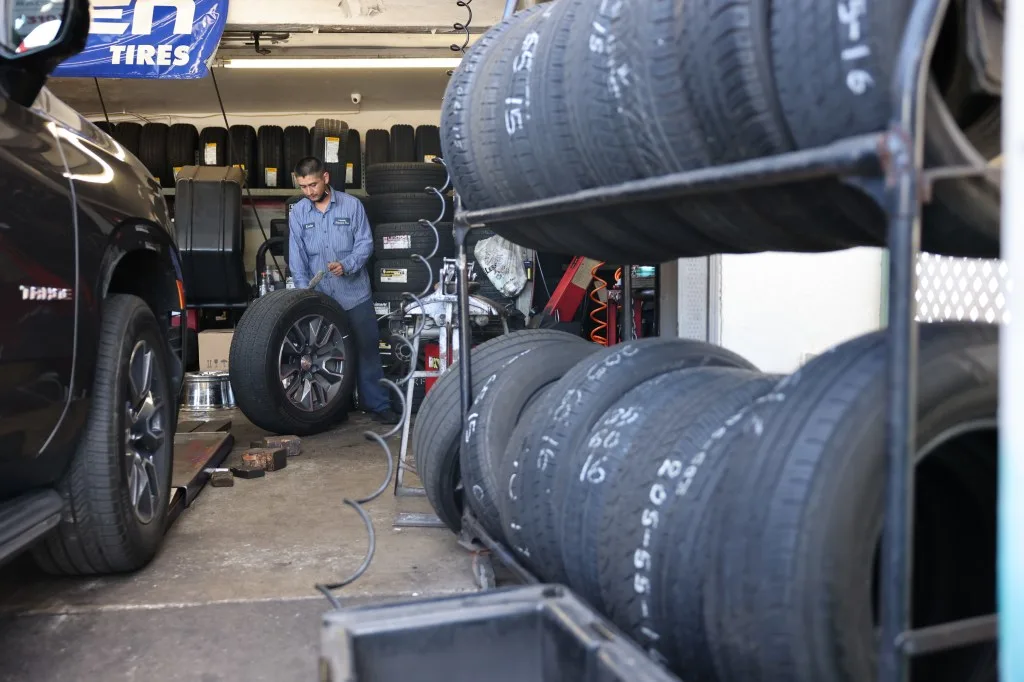
The distributional concern is still material. Drivers who can absorb a higher purchase price may wait for energy savings to accrue. Lower-income motorists must fund the entire tire purchase immediately. Long Beach retailer Miguel Santana said price-sensitive customers could delay replacement or turn to used tires. That is an access risk raised by industry participants, not a demonstrated outcome of the regulation.
Retailers also face a systems-integration task. Covered models manufactured from 2029 will need to be listed in the commission’s approved database and satisfy the applicable requirement or exemption. Manufacturers and brand owners provide model and test information, while dealers will need inventory controls capable of distinguishing eligible products. The U.S. Tire Manufacturers Association has asked for clarity on compatibility, enforcement and fair competition, especially where imported products and specialized applications complicate verification.
Tires manufactured before 2029 and tires already installed on vehicles are not subject to the new performance limits. The first meaningful test will come as manufacturers publish compliant product lines and retailers begin stocking 2029 inventory. That transition will show whether lower rolling resistance reaches entry-level tires broadly or remains an efficiency benefit purchased through fewer, more expensive choices.
| More aerospace and engineering stories, right in your MSN feed. Follow AMI on MSN |
By Thomas Caldwell — AMI’s senior editor for mechanical and mobility engineering, covering vehicle electronics, systems integration, electrification, chassis systems, propulsion, and safety policy.