Russian Jet-Powered Geran Drones Keep Kyiv Under Alerts for Nearly 15 Hours
Speed changes more than the odds of interception. With less time to detect, classify and engage an incoming aircraft, a faster drone can keep an air-defense network and the city beneath it cycling through alerts even when only small groups are approaching. That pressure was visible in Kyiv on August 27, when 13 air-raid alerts lasted a combined 872 minutes, or nearly 15 hours, disrupting metro service and contributing to long-distance train delays exceeding 17 hours.
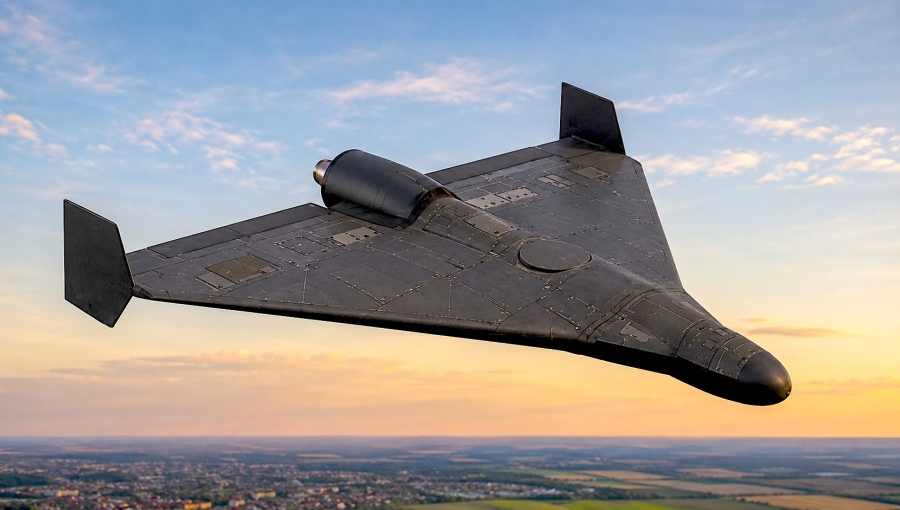
The newer jet-powered Geran drones are described as faster and more maneuverable than the propeller-driven Shahed-type aircraft that have become a persistent threat over Ukraine. Their performance reduces defenders’ reaction time and makes them more difficult for the current generation of inexpensive interceptor drones to catch. That matters because drone-on-drone interception has become an important, comparatively economical layer of Ukraine’s air defense.
Russia has also been sending small groups toward Kyiv at staggered intervals, sometimes only 30 to 60 minutes apart. The Institute for the Study of War assessed that these repeated waves are intended to prolong warnings, repeatedly send civilians toward shelters and interrupt transportation and commerce even when most incoming aircraft are intercepted. By late afternoon on August 30, Kyiv had undergone eight more alerts.
The disruption is therefore not limited to whether a drone reaches a target. Above-ground sections of the Kyiv Metro stop operating during alerts, while underground stations serve as shelters. Businesses may suspend service, workers and customers must seek cover, and logistics operators face repeated pauses that can propagate through delivery schedules. A subsequent strike series lasting more than 28 hours involved more than 550 drones and loitering munitions, illustrating how sustained volume and timing can impose consequences well beyond individual engagements.
Faster drones strain the low-cost interception layer
Ukraine’s interceptor drones were developed partly to avoid spending scarce, expensive surface-to-air missiles against much cheaper unmanned aircraft. According to figures reported by Defense News, drones were credited with more than 70% of Shahed downings over Kyiv in February. That approach depends on producing interceptors in large numbers and giving them enough speed, sensing and control performance to reach their targets.
Jet propulsion puts pressure on that model. The International Institute for Strategic Studies assessed that faster Geran variants could outrun many fixed-wing, rotary-wing and interceptor-drone platforms currently used in counter-drone missions. Higher speed may also require defenders to rely on more capable and generally more expensive or slower-to-produce equipment.
This creates an industrial problem as much as an aerodynamic one. Ukraine must develop an interceptor that can close on the faster aircraft, integrate it with detection and command networks, demonstrate reliable performance and then manufacture enough units for sustained operations. A prototype that succeeds in testing does not provide citywide coverage until production, training, maintenance and distribution catch up.
Defense Minister Yevhenii Khmara said four prospective interceptor systems capable of downing the new jet-powered drones had been tested. The successful designs, however, had not yet reached scaled production. That gap leaves Ukraine balancing low-cost drone interceptors against more capable air-defense weapons whose inventories are harder and costlier to replenish. President Volodymyr Zelenskyy has separately said the country needs at least 300 additional Patriot interceptors for the winter.
Continuity planning becomes another layer of defense
The repeated alerts are arriving alongside damage to warehouses, parcel-sorting sites and retail distribution facilities around Kyiv. Russia’s Defense Ministry claimed that logistics centers were targeted because they handled dual-use products and drone-industry components, although Reuters could not independently verify that assertion.
Ukrainian retailers and logistics companies are responding by rerouting supplies and spreading inventory across more locations. Nova Poshta has said it is increasingly using individual branches as local warehouses, reducing reliance on a smaller number of centralized facilities. Agriculture Minister Taras Vysotskyi estimated that roughly 90% of food-logistics infrastructure operated by Ukrainian retail chains had been destroyed, while stressing that this did not mean the country faced an imminent food shortage.
Officials are also drafting procedures intended to keep transportation, businesses, public institutions and logistics systems operating during prolonged warnings. That work recognizes a central limitation of interception alone: air defense may stop an aircraft, but it cannot recover the hours lost each time a rail line, store, school or distribution network must pause.
Until faster interceptors move from successful tests into dependable mass production, Kyiv faces two linked engineering challenges catching jet-powered Gerans with an affordable defensive layer and designing public services that can continue functioning when 13 alerts consume nearly 15 hours of a single day.
| More aerospace and engineering stories, right in your MSN feed. Follow AMI on MSN |
By Stephen Wallace — Editor for AMI’s aerospace integration and unmanned mobility coverage, focused on drone manufacturing, VTOL systems, autonomous networks, and air-ground mobility links.