James Webb Finds Three Feeding Black Hole Candidates 1.2 Billion Years After Big Bang
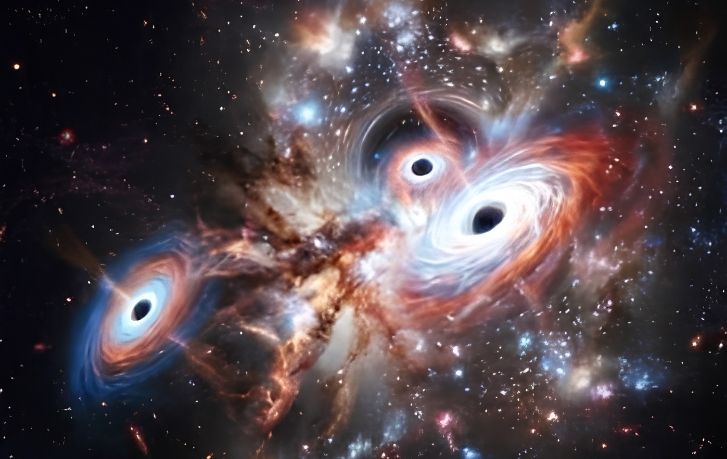
The James Webb Space Telescope has helped researchers distinguish three candidate actively feeding black holes inside one galaxy seen only 1.2 billion years after the Big Bang. The international team led by Hannah Übler describes the system as the first trio of active black-hole candidates identified in the distant universe.
The result is less like a photograph of three separate objects than a forensic reading of their light. Webb could not resolve the two central candidates as individual points. Instead, its Near-Infrared Spectrograph, or NIRSpec, separated their spectral signatures by measuring where different portions of a hydrogen emission line appeared to originate.
How Webb separated objects it could not image
The galaxy, designated J0148-4214, has a measured redshift of 5.0167. Its light traveled approximately 12.5 billion years before reaching Webb, giving astronomers a view of the galaxy during a relatively early stage of cosmic history.
Researchers focused on broad H-alpha emission, a spectral signature from hydrogen. The broadening corresponded to gas moving at estimated speeds from 430 to 2,920 kilometers per second. That signature appeared in hydrogen but not in bright oxygen lines associated with thinner gas farther from the presumed central objects.
NIRSpec’s integral field unit recorded a spectrum at each position across the galaxy rather than reducing the target to one combined spectrum. The team then used spectro-astrometry to track small shifts in the apparent origin of blue-shifted and red-shifted light across the H-alpha line. Those shifts supported the interpretation that two sources sit near the galaxy’s center, separated in projection by about 620 light-years, even though Webb could not display them as two distinct points.
A third candidate was identified approximately 5,500 light-years from the center. According to the researchers, only one of the three likely would have been detected without NIRSpec’s spatially resolved data. That is the central instrument payoff: spectroscopy extracted positional information below the threshold at which ordinary imaging could cleanly separate the central pair.
One candidate may be growing unusually fast
The estimated black-hole masses are approximately 80 million, 600,000 and 2 million times the Sun’s mass. The galaxy’s entire stellar population is estimated at about 1.3 billion solar masses, making the candidate black holes a substantial component of the system.
The smallest central candidate is particularly notable. It appears to be feeding faster than its 80-million-solar-mass neighbor and above the Eddington limit, the conventional threshold at which outward radiation pressure is expected to resist further inflow. If that interpretation holds, it would provide another observational test for models in which short periods of unusually rapid feeding helped black holes become massive early in cosmic history.
Mergers offer a second possible growth route. The paper estimates that dynamical friction the gradual loss of orbital energy as massive objects move through surrounding matter could bring the central pair together within roughly 700 million years. The outer candidate might be moving inward, or it could have been displaced by gravitational recoil following an earlier merger. Neither history has been confirmed.
The three-black-hole interpretation remains provisional
The researchers considered supernovae, shocks, winds and massive stars as alternative explanations for the broad emission before concluding that gas discs around feeding black holes provided the best fit. Best fit, however, does not mean a direct detection of three event horizons or a settled reconstruction of the galaxy’s merger history.
The single-epoch mass estimates carry uncertainties of approximately a factor of three. An arXiv preprint also flags the possibility that the values may require a downward correction by an order of magnitude. That uncertainty matters most for the apparent feeding rate: a changed mass estimate would alter how far the smallest candidate sits above the theoretical Eddington limit.
Nor can one galaxy establish that triple systems were common in the early universe. The same group used Webb in 2024 to identify a merging pair of massive black holes in another galaxy seen when the universe was 740 million years old, but the observational census of such systems remains limited.
J0148-4214 therefore serves as a new test case rather than a population-level conclusion. Its strongest contribution is methodological: Webb’s spatially resolved spectroscopy found evidence for multiple feeding sources where imaging alone could not separate the central pair. Confirming their masses, trajectories and eventual merger history will require additional observations and those measurements will decide whether this system truly represents an unusually fast route to building enormous black holes.
| More aerospace and engineering stories, right in your MSN feed. Follow AMI on MSN |
By David Whitaker — Associate editor for AMI’s aerospace and drone systems desk, translating flight systems, aircraft programs, spaceflight, and UAV developments into accessible technical stories.