Air Force Needs 72 New Fighters Annually, but Factories Cannot Deliver
Seventy-two new fighters a year is the U.S. Air Force’s stated requirement for keeping its fighter fleet steady. The current budget buys 45, leaving a 27-aircraft annual gap and the service says the industrial base cannot presently produce enough aircraft to close it.
Air Force Vice Chief of Staff Gen. John Lamontagne said in early June 2026 that demand was exceeding contractor production capacity. No bill can legislate a factory into producing faster than its current capacity allows, he said. The Air Force described the 72-fighter goal as “not currently achievable.” That distinction matters: appropriations can establish demand, but they cannot instantly add trained workers, qualified suppliers, tooling, engines or integration capacity.
The F-35 bottleneck extends beyond final assembly
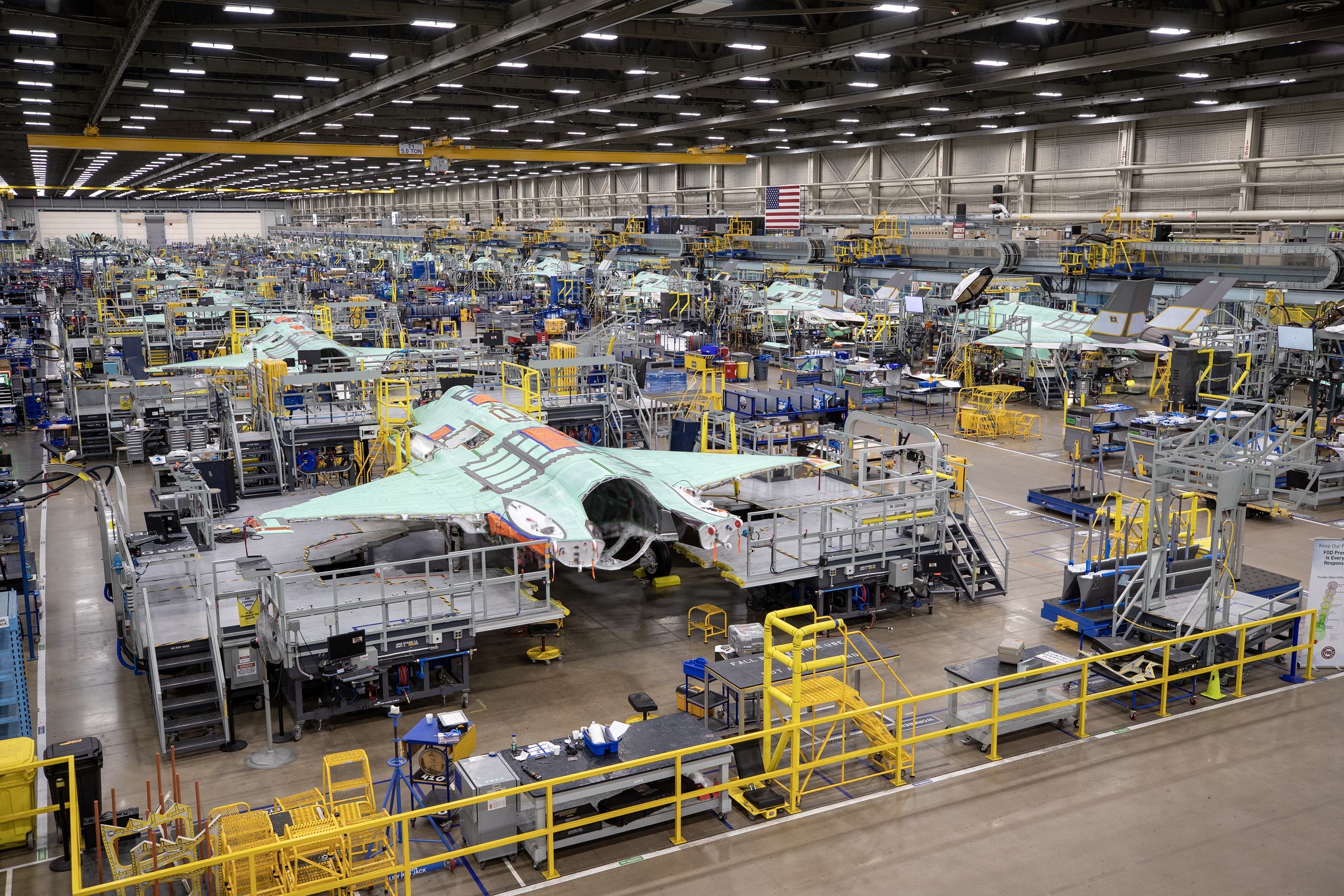
The largest constraint is not simply how quickly Lockheed Martin can move airframes through its Fort Worth plant. That facility was designed to produce 156 F-35s annually at full rate, but completed aircraft still require engines, thousands of components and an accepted hardware-and-software configuration before delivery.
Technology Refresh 3, or TR-3, illustrates the integration problem. The package provides the computing hardware and software foundation required for the F-35’s Block 4 configuration. Originally due in April 2023, it was expected in 2026. Lockheed continued assembling aircraft during the delay, at one point accumulating more than 100 jets that could not be delivered with the required upgrade.
That backlog shows why assembly totals alone can misrepresent usable output. A structurally complete fighter is not equivalent to an accepted aircraft when its avionics baseline remains unfinished. The program can keep factories active and preserve some production flow, but incomplete integration shifts work downstream and creates another queue for modifications, testing and acceptance.
Propulsion has imposed a separate limit. All 123 Pratt & Whitney F135 engines delivered in 2024 were late, with an average delay of 238 days. The Government Accountability Office assessed that delayed engine deliveries posed a significant risk to operational readiness. An aircraft without its engine cannot progress normally through final production and delivery, regardless of how much capacity exists elsewhere on the line.
Missing parts turn capacity into a network problem
At the beginning of 2025, Lockheed was reportedly waiting for more than 4,000 parts and components needed for F-35 production. About 1,600 were associated with TR-3 and Block 4. Some constrained items rely on specialized alloys or composites from a single source, while others have been affected by semiconductor disruptions.
This makes fighter output a network-wide calculation rather than a single factory rate. Adding a shift at final assembly has limited value if a sole-source supplier cannot expand its own qualified process. Aerospace components also cannot always be transferred rapidly to a new vendor: materials, manufacturing methods and quality systems may require validation before parts can enter production.
Skilled labor creates a similar boundary. The F-35 and F-15EX compete for engineers, machinists and other specialized workers alongside the B-21 bomber, T-7A trainer, Sentinel program and classified projects. Hiring alone does not immediately create productive capacity because technical workers require training, while certain manufacturing and integration tasks depend on accumulated experience.
The F-15EX adds aircraft, but not instant capacity
The Air Force is also buying Boeing’s F-15EX Eagle II as a non-stealthy bridge while F-35 output remains constrained and future fighters remain years away. The planned F-15EX fleet had risen to 267 aircraft by mid-2026. Its updated avionics and fly-by-wire controls modernize the established F-15 design, but the aircraft draws on its own finite assembly, engine and supplier base.
In August, the Air Force awarded Boeing a broad F-15 contract with a ceiling of $131.2 billion, covering production, upgrades and sustainment for U.S. and international customers. The ceiling is not a commitment to spend the full amount or proof that factories can immediately raise output. Its practical value is the potential to streamline later orders and provide a more stable demand signal, which can support supplier, tooling and workforce investments over time.
Even that expansion carries engineering work. The enlarged F-15EX plan introduces cost and schedule uncertainty and requires a technical refresh to address diminishing manufacturing sources, including obsolete radar, engine and electronic-warfare systems. Boeing has also been working to increase production after delays, demonstrating that an older airframe family does not eliminate modern supply-chain constraints.
The Air Force therefore faces two different gaps: Congress must fund 27 more aircraft annually to reach the stated requirement, while industry must build the sustained capacity to produce and deliver them. Until software integration, engine delivery, component supply and labor capacity improve together, the fleet is projected to keep shrinking through at least 2028 before potentially stabilizing.
| More aerospace and engineering stories, right in your MSN feed. Follow AMI on MSN |
By David Whitaker — Associate editor for AMI’s aerospace and drone systems desk, translating flight systems, aircraft programs, spaceflight, and UAV developments into accessible technical stories.