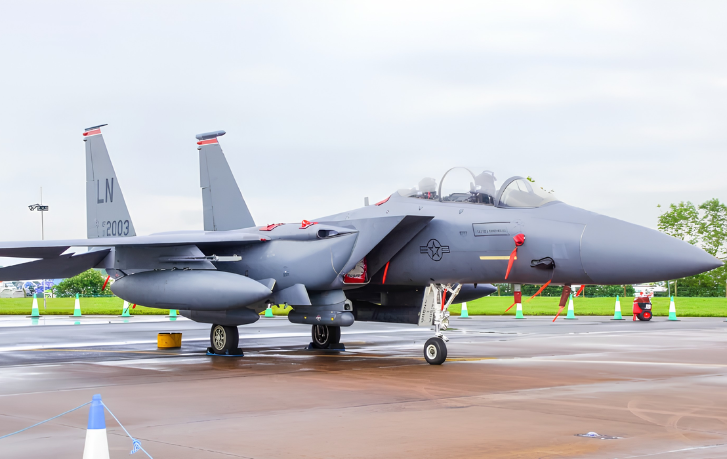
Boeing’s $131.2 Billion F-15 Contract Is a Ceiling, Not Spending
Boeing now holds an F-15 production and support contract with a $131.23 billion ceiling, but the government has not ordered $131.23 billion worth of fighters. The Aug. 24 contract announcement established a long-term vehicle through which the U.S. Air Force can issue future orders for aircraft, upgrades, maintenance support and related work. Only $343,740 in fiscal 2026 research, development, test and evaluation funding was obligated at the award.
That gap between the headline number and the initial obligation defines Boeing’s F-15 Eagle Crest contract. It is an indefinite-delivery, indefinite-quantity arrangement: The ceiling sets the maximum value of orders that may be placed, not a minimum purchase. The announcement included no order for a fixed number of new aircraft, and spending will depend on later decisions by the Air Force and participating foreign governments.
One vehicle covers production and fleet support
Eagle Crest is unusually broad because it can carry work across much of the F-15 life cycle. Its permitted scope includes aircraft production, systems integration, modernization, upgrades, retrofits, sustainment and the establishment of organic depot-maintenance capabilities. That means future task orders could fund anything from new airplanes to engineering changes and long-term support for aircraft already in service.
Combining those activities under one contracting framework can reduce the need to establish a separate vehicle for each requirement. It does not, however, eliminate the technical, budgetary or approval work behind individual orders. Each production lot, upgrade package or maintenance initiative still needs its own funding and defined scope.
The distinction matters for taxpayers because the final cost will be shaped by the mix of work, not simply by the number of fighters involved. New-aircraft production, fleet-wide electronics updates, structural retrofits and depot preparation are different engineering efforts with different labor, material and testing demands. The ceiling alone does not show how much will go toward each category.
Task orders will determine the industrial effect
The ordering period is expected to run through Aug. 24, 2031, with an option to extend it to Aug. 24, 2036. Work is expected to continue through August 2037 at Boeing’s St. Louis operation. That long horizon gives the Air Force room to place orders as requirements and budgets develop, but it does not by itself provide Boeing or its suppliers with a stable annual production rate.
That is the central industrial tradeoff. A large ceiling gives customers flexibility and leaves room for major future orders without immediately committing the full amount. Suppliers, meanwhile, make decisions about tooling, staffing and production capacity based on funded demand. If orders arrive unevenly or remain well below the ceiling, the contract’s practical effect on manufacturing capacity will be smaller than its maximum value suggests.
A 2020 Air Force contract for export F-16s illustrates the difference between a vehicle and an order. That arrangement carried a $62 billion ceiling, but the Air Force simultaneously issued a separate $4.94 billion order for 90 aircraft. No comparable aircraft order accompanied the Eagle Crest announcement.
The potential fleet is large, but not uniform
The contract can support the Air Force, Air National Guard and foreign military sales involving Japan, Israel, Saudi Arabia, South Korea, Singapore, Indonesia and Poland. Flightglobal’s 2026 fleet figures indicate that modernization or upgrade work could potentially touch at least 897 F-15s, or more than 1,000 if ordered but undelivered aircraft are counted.
That does not mean every listed country will order the same work or any work at all. Some customers operate existing F-15 fleets, while Indonesia and Poland do not currently fly the aircraft. Their inclusion preserves a contracting path for possible future requirements rather than confirming purchases.
The depot provision could have a particularly durable readiness effect. Organic depot capability allows Air Force facilities to perform heavy maintenance rather than relying exclusively on Boeing. Establishing that capacity can require facilities, tooling, technical data and workforce preparation, so it represents more than routine maintenance spending. Whether that capability expands, and how quickly, will depend on the task orders issued under Eagle Crest.
The contract was awarded on a sole-source basis, placing additional importance on the visibility provided by future orders. Those orders will show whether Eagle Crest primarily becomes a new-aircraft production channel, a modernization framework for a fleet approaching 1,000 aircraft, or a long-term sustainment and depot program. Until then, $131.23 billion measures authorized contracting capacity not fighters purchased or money guaranteed to Boeing.
| More aerospace and engineering stories, right in your MSN feed. Follow AMI on MSN |
By David Whitaker — Associate editor for AMI’s aerospace and drone systems desk, translating flight systems, aircraft programs, spaceflight, and UAV developments into accessible technical stories.