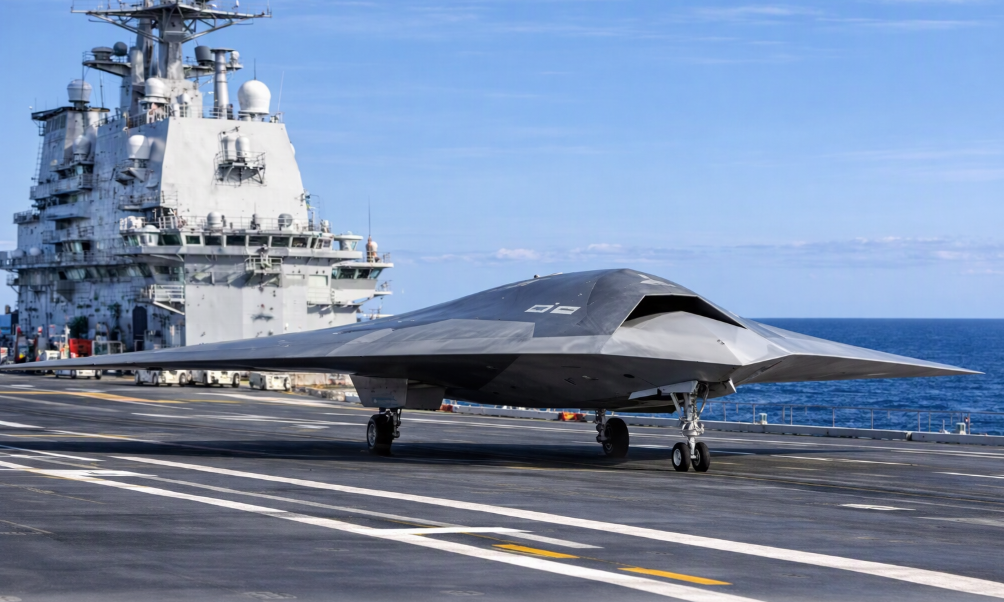
China Says GJ-21 Stealth Drone Took Off and Landed on Sichuan
China says its GJ-21 stealth reconnaissance and strike drone has completed its first takeoff and landing aboard the Sichuan, the country’s first Type 076 amphibious assault ship. State news agency Xinhua called the shipboard trial “a breakthrough in China’s amphibious assault ship programme,” presenting it as evidence that the navy can operate a reusable fixed-wing stealth drone from a large vessel at sea.
The reported flight moves the Sichuan beyond carrying helicopters and amphibious equipment. Its full-length deck, electromagnetic catapult and arresting system are intended to support fixed-wing aircraft that cannot launch vertically or settle onto a small landing pad. Pairing those systems with the GJ-21 indicates that the ship and aircraft have reached at least an initial level of launch-and-recovery integration, although no detailed test results, operating tempo or reliability figures were disclosed.
The Sichuan was launched in December 2024 and displaces more than 40,000 metric tons at full load. It has a twin-island superstructure and can carry fixed-wing drones, helicopters and amphibious equipment. China’s navy said the ship sailed to the South China Sea in April for scientific testing and training, characterizing the deployment as routine and not directed at any specific party. State broadcaster CCTV later reported consecutive sea trials in late October without identifying their locations.
Launching is only half of the engineering problem. A fixed-wing drone returning to a ship must approach a moving deck while accounting for vessel motion, wind and disturbed airflow behind the ship. Its flight-control system must keep the aircraft within tight position, speed and attitude constraints before the arresting equipment rapidly brings it to a stop.
Research into autonomous carrier landings illustrates the control burden. Predictive landing methods model deck movement and environmental disturbances while respecting actuator, airspeed and attitude limits. That requires reliable sensing, low-latency computation and close coordination between the aircraft’s controls and the ship’s landing equipment. A successful recovery therefore tests more than the drone itself: it exercises an interconnected system spanning deck machinery, guidance, communications and flight-deck procedures.
The broader concept has an established precedent. In 2013, the U.S. Navy’s X-47B demonstrator made the first arrested landing by an unmanned aircraft on a modern aircraft carrier. It subsequently launched by catapult and performed another arrested landing. That program showed the feasibility of large unmanned aircraft operating in the carrier environment, but translating a demonstration into routine service requires repeated testing, maintainability work and dependable performance across changing sea conditions.
The GJ-21 first appeared publicly during a Beijing military parade in 2025 marking the 80th anniversary of the end of World War Two. It was displayed with several types of weapons. Xinhua describes it as China’s first carrier-based stealth reconnaissance and strike drone, but publicly available details about its dimensions, propulsion and demonstrated range remain limited.
Claims about its economics and operating reach are also still attributed assessments. The state-run Global Times quoted military expert Zhang Xuefeng as saying the GJ-21 has a substantial combat radius despite being smaller than China’s J-35 and J-20 stealth fighters. He characterized the drone as low cost and reusable, saying it could be recovered and deployed repeatedly rather than expended like a missile. He also said it could carry small glide-guided bombs.
Reusability would give the aircraft a different cost structure from a one-way system, but recovery alone does not establish low operating cost. Shipboard drones still require inspections, maintenance, spare parts, deck crews and functioning catapult and arresting equipment. Their practical value depends on how often they can fly, how reliably they return and how quickly the aircraft and ship can be prepared for another sortie. China has not released data documenting those measures for the GJ-21.
The trial’s confirmed public significance is narrower but still substantial: China says a stealth fixed-wing drone both departed from and returned to an amphibious assault ship equipped for catapult launches and arrested recoveries. The next meaningful measure will be whether that pairing progresses from a reported first cycle to repeatable shipboard operations the point at which reusability becomes an operating capability rather than an attributed advantage.
| More aerospace and engineering stories, right in your MSN feed. Follow AMI on MSN |
By Stephen Wallace — Editor for AMI’s aerospace integration and unmanned mobility coverage, focused on drone manufacturing, VTOL systems, autonomous networks, and air-ground mobility links.