Ukraine’s Ground Robots Stop Some Drones, but Wider Air Defense Remains Limited
Ukrainian ground robots have reportedly stopped some Russian aerial drones, but protecting an individual machine is a narrower task than providing dependable mobile air defense for troops. Most of the robot-mounted counter-drone systems described by Ukrainian units and developers remain in testing or limited use, leaving a substantial gap between successful interceptions and a capability that can protect a wider area consistently.

The immediate objective is survivability. Ground robots are increasingly handling logistics, casualty evacuation and other work in dangerous areas near the front, where persistent surveillance and strike drones make human movement hazardous. Mykyta Rozhkov said Russian forces are increasingly targeting the robots, creating demand for cameras, jammers, weapons, smoke systems and physical interceptors that can help the machines complete their missions.
Oleksandr Yabchanka, head of robotic systems for Ukraine’s Da Vinci Wolves Battalion and co-founder of Defence Robotics UA, said ground robots had successfully stopped some drones. He sees particular potential in using robotic systems to defend low-altitude airspace, although he cautioned that it would be incorrect to promise a substantial transformation within the next 12 months. The number of interceptions and the conditions under which they occurred have not been independently established.
Detection is only the first control problem
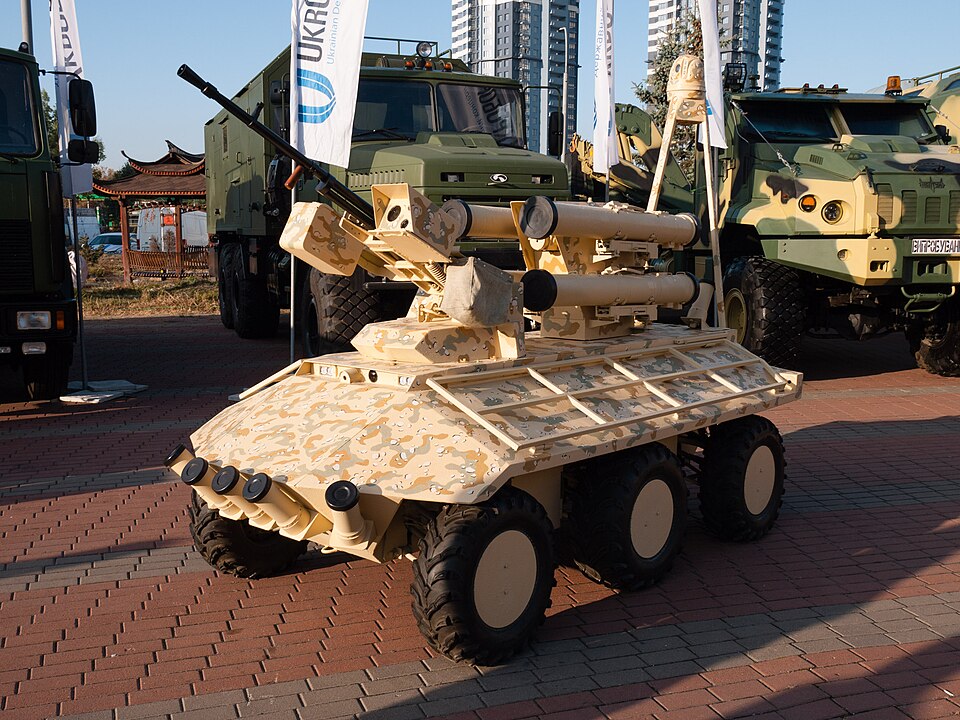
The emerging systems divide broadly into sensing, electronic disruption and physical interception. Frontline Robotics is working with a partner on a package that uses cameras and sensors to find hostile drones, while withholding details of how targets are engaged. UFORCE says its AI-assisted Predator weapons station can track and fire at drones, and Ukraine’s 42nd Separate Mechanized Brigade previously described a machine gun mounted on a Liut robot shooting down Russian drones.
Other developers are pursuing capture or deflection rather than gun-based interception. Rovertech is developing a combination of sensors, AI-assisted detection and a net launcher. Ratel Robotics has started serial production of a protective system incorporating net launchers, while Ukraine’s 100th Separate Mechanized Brigade said it had deployed a net-launching active-protection system that brought down an approaching drone. Some units have also moved robots carrying electronic-warfare equipment forward to jam Russian drones, although that capability is not widespread.
Combining these functions on one mobile platform creates a demanding control chain. A robot must detect a small aerial object, maintain a usable track while both vehicles may be moving, distinguish a threat from other objects and position its countermeasure in time. AI-assisted detection can help process sensor information, but it does not remove the need for reliable sensing, communications, operator supervision and a suitable engagement mechanism.
The distinction between self-protection and area defense is largely one of coverage and integration. A net launcher or weapon that protects its host robot may only need to address an immediate approach. A mobile air-defense platform must instead contribute repeatable detection and interception across a useful area while coordinating with other sensors and friendly systems. It must also remain mobile, powered and maintainable without losing the logistical advantages that made a ground robot attractive in the first place.
Fielding requires more than a successful interception
Brave1, Ukraine’s state-backed innovation platform, says armed robots are starting to be used against aerial drones and identifies anti-aircraft weapons and protection as priorities. Ukraine is also building specialized defense-technology organizations covering unmanned systems, air defense and electronic warfare. The Ukrainian Ministry of Defence says these centers are intended to consolidate operational experience, assess technologies and connect military requirements with development and resources.
That institutional work addresses a central deployment limit: a counter-drone device is only one part of an operational system. Testing must establish how reliably it detects, tracks and responds under varied conditions. Units then need training, maintenance, replacement parts and procedures for integrating it with existing defenses. A March 2026 U.S. military counter-drone test update made the same broader point in a different setting, identifying training, sustainment and maintenance alongside technology as necessary elements of effective defense.
For now, Ukraine’s counter-drone ground robots are best understood as an expanding set of self-protection experiments with some reported field successes. Their larger promise is clear: machines already sent into areas too dangerous for routine human movement could eventually carry short-range protection forward with them. Reaching that point requires the present collection of cameras, sensors, jammers and interceptors to become a validated, supportable and coordinated air-defense capability rather than protection available on only a limited number of robots.
| More aerospace and engineering stories, right in your MSN feed. Follow AMI on MSN |
By Jonathan Barrett — Editor for AMI’s future mobility and autonomous systems section, with two decades covering robotics, e-mobility, drone-vehicle convergence, and transport mechanical systems.