Air Force Sends All Three Presidential 747s to One Manila Airport
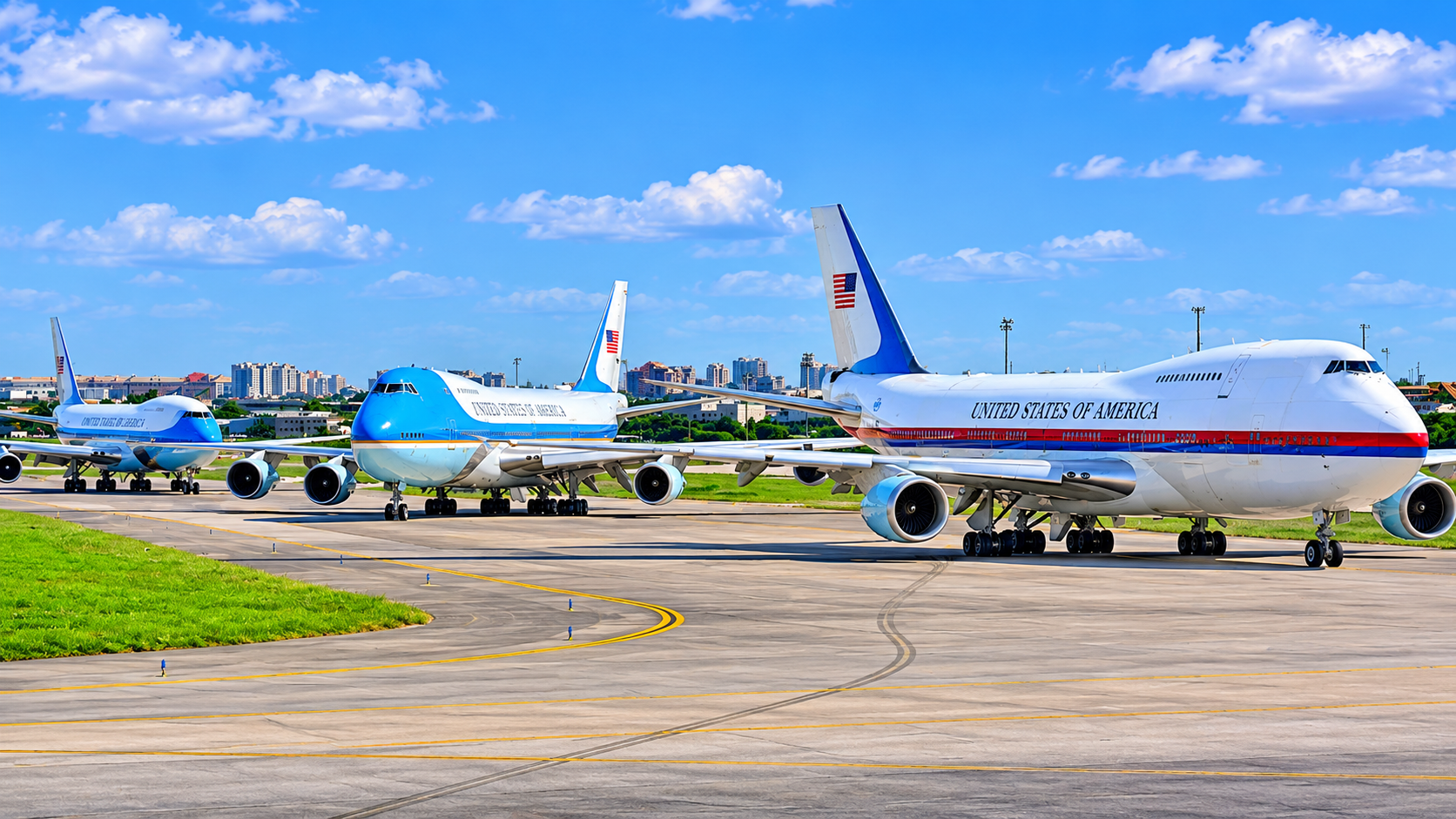
Backup aircraft normally give presidential airlift planners an additional option during major overseas travel. In Manila, however, both aging blue-and-white VC-25A jets and the newly converted interim Boeing 747-8 were parked at Ninoy Aquino International Airport at the same time concentrating all three aircraft identified as the current presidential 747 fleet at one foreign airport.
An image attributed to aviation writer Mond Ortiz documented the three-aircraft gathering during President Donald Trump’s visit to the Philippines. Trump arrived aboard the newer 747-8 for a state visit, the ASEAN-U.S. Special Summit and a Quad leaders’ meeting. The White House had not publicly explained why all three widebody aircraft were sent to Manila.
The unusual deployment does not mean the presidential airlift mission lacked other supporting aircraft. Presidential travel involves a much larger network of transports, communications equipment and specialized crews. But within the reported three-aircraft 747 fleet, placing every available jet at one airport reduces the geographic separation normally associated with sending an additional aircraft as backup.
Three aircraft bridge two generations
The Manila lineup captures a fleet transition that is becoming harder to manage. The two VC-25As are highly modified Boeing 747-200-based aircraft that entered presidential service in 1990. At 36 years old, they require continued maintenance and logistical support while the Air Force waits for their permanent successors.
The third aircraft is a former Qatari Boeing 747-8 converted by L3Harris for interim presidential service. It began operating in that role in July 2026, providing another large presidential transport while Boeing works on two purpose-built VC-25Bs. Those permanent aircraft are now expected around 2028 and 2029 after originally being targeted for completion by the end of 2024.
The bridge aircraft adds availability, but an accelerated conversion is fundamentally different from the extensive engineering program behind the permanent VC-25Bs. A commercial 747-8 must be adapted around presidential communications, electrical-power demands, specialized interiors and other mission equipment. Integrating those systems affects aircraft structure, wiring, testing, certification and long-term maintenance not just cabin furnishings.
Critics have questioned whether the interim aircraft carries communications and defensive capabilities equivalent to the legacy VC-25As. No official technical finding has identified the bridge jet as deficient. Its stated role is temporary, and additional work was reported as planned, while the two permanent aircraft remain the long-term solution.
A roughly $4 billion program remains years from completion
Boeing’s permanent VC-25B effort is a roughly $4 billion fixed-price program covering the engineering and modification of two 747-8 airframes. The contract structure places much of the financial impact of overruns on Boeing, which has recorded repeated charges as labor shortages, supplier disruption, wiring changes, interior-design work and structural rework extended the schedule.
Those delays create a direct fleet-management consequence for the Air Force. The service must keep two older aircraft available, introduce and support a one-off interim conversion, and prepare for two substantially different permanent replacements. Each configuration brings its own maintenance documentation, training demands, spare-parts needs and modification status. A third aircraft can increase scheduling flexibility, but operating three nonidentical jets also broadens the sustainment burden.
Manila therefore presented both sides of the transition. The Air Force could place three presidential 747s at one overseas destination, demonstrating more immediate capacity than the two-aircraft legacy fleet alone could provide. Yet gathering all three also made the underlying constraint visible: the service is relying simultaneously on 36-year-old aircraft and an interim conversion because Boeing’s permanent replacements remain years away.
The next major step is expected to be the first flight of the lead permanent VC-25B in 2027, followed by delivery around 2028. Until then, every major trip must be planned around an uncommon mix of legacy aircraft, a bridge jet and a replacement program still moving through modification and testing.
| More aerospace and engineering stories, right in your MSN feed. Follow AMI on MSN |
By David Whitaker — Associate editor for AMI’s aerospace and drone systems desk, translating flight systems, aircraft programs, spaceflight, and UAV developments into accessible technical stories.