Air Force Flies C-17 With Robot-Formed Panel After Tooling Shortage
The difficult part of replacing one damaged C-17 nose panel was not forming the metal. It was justifying the dedicated tooling needed to make a single component. Boeing determined that no vendor was willing to create that tooling, leaving the U.S. Air Force without a conventional source for the isolated replacement part.

Robotic incremental sheet forming provided a tooling-light alternative. The Air Force Rapid Sustainment Office and University of Dayton Research Institute progressively formed sheet metal into a replacement left nose panel, then put the component through fit checks and testing before installation. According to the Air Force’s official account of the repair, the C-17 returned to flight at Wright-Patterson Air Force Base on July 30. The office described it as the first flight of a part made through its incremental sheet-forming capability.
A one-part tooling problem
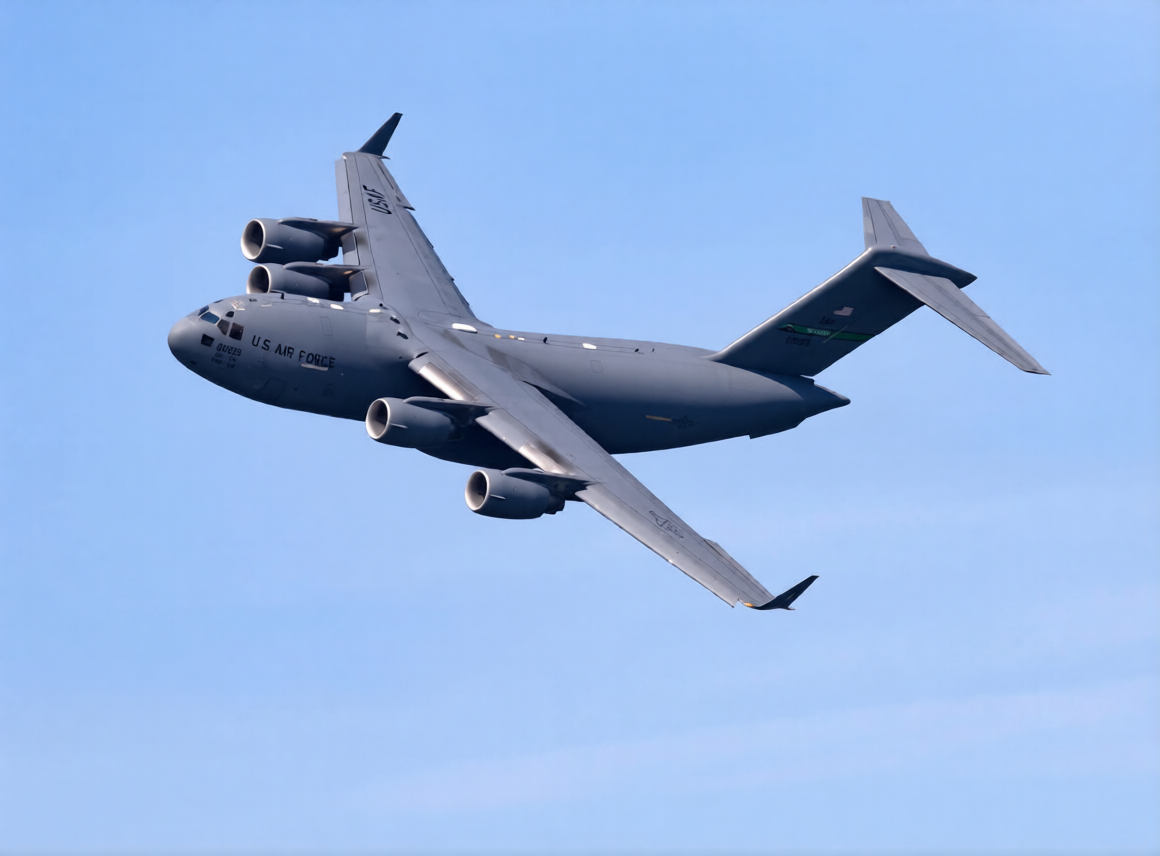
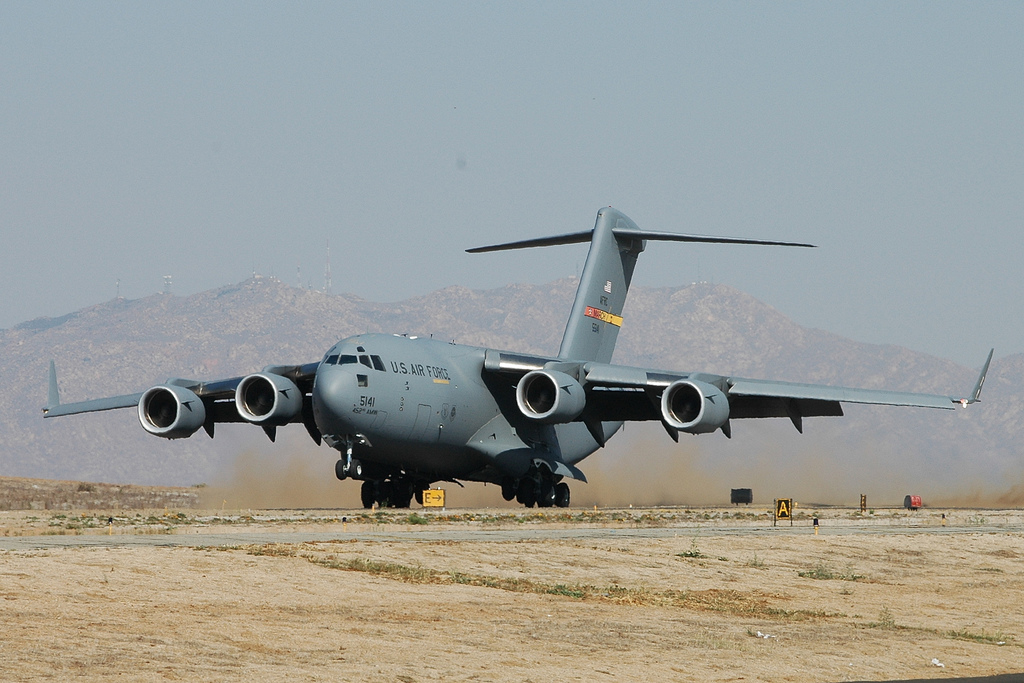
The aircraft, assigned to the 445th Airlift Wing at Wright-Patterson in Ohio, had been damaged on March 4, 2025, while parked at Perot Field Fort Worth Alliance Airport in Texas. Severe weather, including wind microbursts of up to 80 mph, blew two privately owned Bombardier Challenger business jets into the C-17. The impact damaged its left-side door, fuselage and nose area.
A temporary left nose-panel repair was qualified by Boeing and approved by the Air Force for the return flight to the Dayton area. The C-17 made that trip with its landing gear down. The 445th Maintenance Group subsequently repaired the door and fuselage, but concluded that the left nose panel needed replacement.
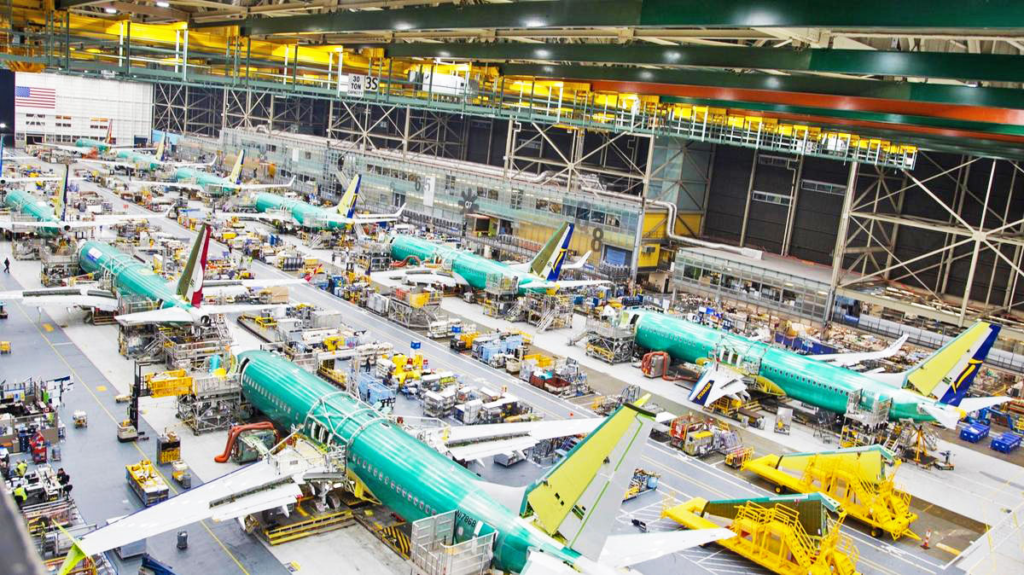
That requirement exposed a familiar low-volume manufacturing constraint. Conventional sheet-metal production can depend on component-specific dies, fixtures or other physical tooling. Those assets make sense when their cost can be distributed across a production run. They become much harder to justify for one panel, particularly when the original production system is no longer active. Boeing completed C-17 production in 2015.
Incremental sheet forming changes that production equation. Rather than using a dedicated die to create the full geometry in one operation, a robotic system progressively deforms a metal sheet along a controlled path. For this repair, the important advantage was not mass-production speed. It was the ability to form a low-volume component without first rebuilding tooling for an aircraft whose production line had closed more than a decade earlier.
Formation was only the first stage
The Rapid Sustainment Office’s Automation and Robotics team selected the panel as a candidate for the process and worked with the University of Dayton Research Institute. Production began in January 2026 at the office’s Integrated Technology Operations Center.
The formed panel then moved through an initial fit check and testing intended to establish that it was suitable for flight. A final fit check followed in April. Boeing and the 445th Maintenance Group installed the completed panel in July, after which the repair team performed a front landing-gear test and made minor adjustments around the nose.
That sequence matters because a robot’s ability to reproduce a shape does not, by itself, establish that an aircraft component is ready for service. Fit, interfaces and the completed installation still had to be evaluated. In this case, the process advanced from robotic forming through checks, testing, installation and an actual return to flight.
Mary Schuler, the Rapid Sustainment Office’s Automation and Robotics lead program manager, said the approach reduced a repair process expected to take years to only a few months. Production itself began in January, the final fit check was completed in April, installation occurred in July and the aircraft flew on July 30.
A narrow but useful sustainment result
This repair does not establish robotic incremental forming as a universal replacement for conventional aerospace tooling. Its demonstrated value is more specific: producing an otherwise unavailable sheet-metal component in a one-off sustainment case, then carrying that part through the checks required for installation and flight.
The Rapid Sustainment Office says it is also producing parts for the KC-135 and F-15. Those efforts remain developing applications; the available information does not establish that the additional parts have completed qualification or flown.
For the C-17, however, the manufacturing chain is complete. A panel that suppliers would not tool for as an isolated order was robotically formed, checked, tested, installed and flown. That is a concrete route around one of aging-aircraft sustainment’s hardest constraints: needing only one part after the industrial system built to make it has disappeared.
| More aerospace and engineering stories, right in your MSN feed. Follow AMI on MSN |
By Edward Collins — Senior editor for AMI’s performance systems and mechanical design coverage, focused on powertrains, drivetrain systems, manufacturing precision, materials, and high-performance engineering.